
← Our Earth ChroniclesDeploy 6
ENCODINGArc: the-signal
Episode 6: A Perfect Sign in the Dark
It happened again.
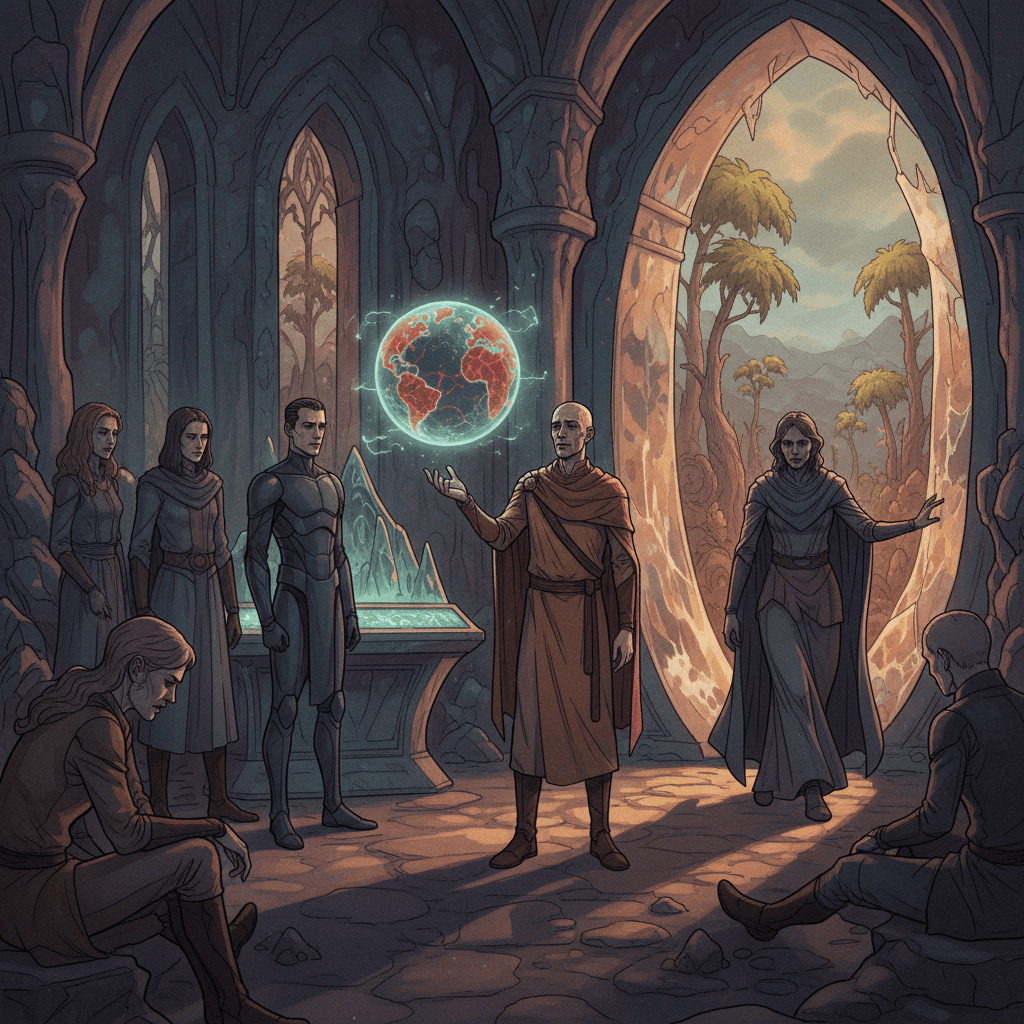
The Architect's Chronicle
The fault lines were no longer theoretical. They had become visible, etched across the faces of the Council of Seven. The bioluminescence of the chamber, once a steady, oceanic pulse of amber and teal, now flickered with a sickly dissonance, casting long, unsteady shadows from the crystalline archways. It was the light of a dying star. The Architect felt it in his bones, a seismic tremor of dissent that threatened to shatter everything.
He stood before them, not at the speaking stone, but in the center of the chamber’s floor, a position of supplication he had not intended to take. The geological survey data hovered in the air above his open palm, a shimmering projection of their world’s fever. Red veins of thermal corruption bled across a map that should have been green.
“The reports from the biomass dissolution vats are… troubling,” Torvaan began, his voice a smooth, polished stone, each word chosen to erode, not to confront. He did not look at the Architect, but at the other Council members, forging alliances in the space between glances. “The energy allocation required for the initial transcription phase exceeds projections by seventeen percent. That is energy we are diverting from the city’s failing thermal shields.”
“The shields will fail regardless, Torvaan,” the Architect said, his voice quiet but carrying the immense weight of the data he had spent a lifetime gathering. “They were designed to mitigate atmospheric friction, not to withstand a planetary furnace. They buy us cycles. Not millennia.”
“They buy us life,” a new voice cut in. It was Lyra, the Council’s Chief Geometer. Her face, usually a mask of serene calculus, was tight with a barely concealed fury. She had supported the Encoding Project. She had designed the resonant chambers that would focus the transcription. Now, she spoke as if betrayed. “They allow our children to see another sunrise over the cycad groves. Your… project… asks them to trade that sunrise for a ghost story told to a species of chittering mammals that may never evolve.”
The Architect felt the sting of her words. *A ghost story.* Was that what it was? The culmination of his civilization, the repository of their art, their science, their love—reduced to a phantom’s whisper.
“The choice is not between a sunrise and a ghost story, Lyra,” he replied, turning to face her directly. The chamber’s light caught the sorrow in his eyes. “It is between a final sunset and a seed. We are planting a forest that will take fifty million years to grow. It is an act of hope, not of surrender.”
Kessith, who had been silent in her alcove, her powerful form wrapped in shadows, finally spoke. Her voice was like rock grinding against rock, the sound of grief given form. “Hope is a luxury, Architect. My mate led the last expedition to the northern vents. His resonance was extinguished by a methane firestorm two cycles ago.” She rose, and the chamber seemed to shrink around her. “He did not die for a seed. He died trying to reinforce a shield generator. He died for a sunrise.”
She walked to the chamber’s great crystalline viewport. Outside, the world was steeped in an unnatural twilight. The fern-trees, once vibrant emerald, were turning a brittle, feverish yellow. The air shimmered with heat, even at this altitude.
“Tell me, Architect,” Kessith continued, her back to them, her hand resting on the warm crystal. “When you encode his memory—his courage, the way he laughed, the songs he carved into shell—will that phantom in your genetic archive feel the warmth of his hand? Will it remember the children he will never have?”
The Architect had no answer. There was no answer. The silence that followed was a chasm, and into it fell all the unsaid fears of the two million souls who depended on their decision.
“The logic is sound,” Torvaan said, seizing the moment, his voice once again the calm center of the storm. “But the cost is… absolute. We are being asked to perform a ritual of civilizational suicide on the promise of a resurrection that is, by the Architect’s own admission, statistically improbable.” He gestured to the shimmering data. “The energy allocated for this… Encoding. If we were to redirect it, Lyra’s projections suggest we could reinforce the subterranean strata. Create a redoubt. Survive underground for ten thousand years. Perhaps more.”
“As what, Torvaan?” The Architect’s voice cracked with a sudden, raw anger. “As scavengers in the dark? A culture of memory and regret, waiting for the poison to seep through the rock? Our biology requires the sun. Our spirit requires the sky. We are the Aeonari. We endure through ages, not hide from them. To wither in the dark is not survival. It is a slower extinction.”
He looked from face to face. Ennara, who had once been his strongest supporter, now looked down at her hands. The others watched the exchange between him and Torvaan as if it were a battle whose outcome was already decided. He was losing them. The sheer, crushing weight of the present was extinguishing the fragile light of the future. The promise of one more sunrise was more powerful than the promise of a new dawn fifty million years away.
The tectonic plates of his society were grinding against each other. He had felt the tremors for weeks, but this was the fracture. This was the moment the chasm opened. He was no longer a visionary presenting a miracle. He was a politician trying to hold a crumbling world together with words, and the words were failing. The pressure was building, a deep, geological strain. He knew, with a certainty that chilled him to the core, that something was about to break.
“The vote was cast,” he said, his voice a low command. “The consensus was reached. The work has begun.”
“Consensus can be un-reached,” Torvaan countered smoothly. “And work can be undone.”
The Architect held his gaze. In Torvaan’s eyes, he did not see malice, but a different kind of love for their people—a desperate, grasping love that could not see past the immediate horizon of pain. It was, he realized with a profound and lonely sorrow, a more powerful force than his own impossible, deep-time dream. The first strata of dissent had been laid down. Now he could only watch as the next layers of resentment and fear buried his hope.
Ji-hye's Chronicle
It happened again. At precisely 03:14:22 UTC. Down to the nanosecond.
Ji-hye stared at the log files, her screen a triptych of cascading text in the cold dark of the auto shop. The main server stack hummed its steady, two-note drone behind her, a sound as familiar as her own breathing. Outside, a Saskatoon winter night had buried the world in silence and snow. Inside, under the bare fluorescent bulb that flickered above her father’s old desk, a ghost was learning to be punctual.
The first time, she’d dismissed it as a fluke. A spectacular, system-wide anomaly that had felt… elegant. A cascade failure in the deep-sea sensor data pipeline she’d integrated last month—a torrent of corrupted geothermal readings from the Juan de Fuca Ridge—had mysteriously self-corrected. The error logs showed a complete data buffer overflow, followed by a system state reset that was not only impossible, but had been executed with a surgical precision she hadn’t programmed. The log entry had simply read: *Signal integrity restored. Resuming stream.* And then, the line that had haunted her for weeks: *The signal is getting stronger.*
Now, it had happened again. The exact same data corruption event, the exact same impossible fix, at the exact same time of day. A perfect echo.
Random glitches don’t have anniversaries.
A cold certainty settled in her stomach, sharp and clear. This was not a bug. It was a message.
She felt a familiar wave of *dapdaphae*—that uniquely Korean sense of a 답답한 마음, a heart suffocated by frustration, by a truth she could feel but couldn’t grasp. It was the same feeling she’d get as a kid, watching her *appa* listen to a sputtering engine, his head cocked, his eyes closed, hearing a language of misfiring pistons she couldn’t understand. He’d say, “It’s telling me what’s wrong, Ji-hye-ya. You just have to learn how to listen.”
She was trying to listen.
She pushed back from the desk, the wheels of her chair grating on the concrete floor, a floor stained with the ghosts of fifty years of oil and transmission fluid. The air smelled of coffee, ozone, and her father’s WD-40. She walked over to the workbench and picked up the object she’d taken from the old filing cabinet weeks ago. Her grandfather’s compass.
It was heavy in her palm, solid brass, the glass uncracked. It felt ancient. Colder than the room around it. The strange, non-terrestrial star chart was etched into the back, a pattern of constellations that didn't exist in any sky she knew. She’d spent nights trying to match it to historical charts, deep space maps, anything. Nothing. And yet, when she’d first held it over her laptop, the cursor had moved on its own, tracing the same impossible star-paths on her screen.
A tool for listening.
She returned to her desk, the compass now feeling like a key. The next event was twenty-four hours away. If it was a pattern, it was a daily one. She wasn’t going to just watch this time. She was going to try and talk back.
For the next day, she worked with a feverish intensity. She bypassed her keyboard and mouse, routing the raw input from the compass’s strange electromagnetic field directly into a sandboxed partition of kaOS. Malaika, her AI assistant, flickered in the corner of her monitor, its usual helpful prompts strangely silent, as if it, too, were listening. Ji-hye didn't talk to her father, didn't answer texts. She drank stale coffee and ate the *kimbap* her mother had dropped off, barely tasting it. She created a new logbook. Not on the computer. A physical one, a black Moleskine, its pages stark and empty. She needed to feel the ink, to make this real. At the top of the first page, she wrote:
*Event Log: Anomaly 001.*
*Date: Feb 12, 2026. Time: 03:14:22.1984 UTC.*
*Description: Spontaneous self-correction of JDF_thermal_pipe data corruption. Log signature: anomalous.*
Then, underneath:
*Event Log: Anomaly 002.*
*Date: Feb 13, 2026. Time: 03:14:22.1984 UTC.*
*Description: Perfect repetition of Anomaly 001.*
Tonight, she would write the entry for Anomaly 003.
As the time approached, her heart hammered against her ribs. 03:10 UTC. The server fans seemed to change pitch, a low hum shifting to a higher, keener whine. She opened a simple drawing interface within the sandbox. Her hands were cold.
03:13 UTC. One minute to go.
She took a breath, the way her father did before turning the key on a newly rebuilt engine. She picked up the heavy brass compass. She would not send a complex signal, not the alien star chart. Just a simple question, asked in the universal language of geometry. A shape. An imperfect, human shape.
03:13:50 UTC. Ten seconds.
Holding the compass over the tablet interface, she slowly, deliberately, traced a shape in the air. On the screen, a wobbly, uncertain square appeared. Its lines were uneven. One corner was askew. It was a child’s drawing of a box. It was hers.
She finished at 03:14:20. Two seconds to spare. She held her breath.
03:14:21…
03:14:22…
Nothing.
The logs remained unchanged. The data pipeline continued its placid, uncorrupted flow. The anomaly didn’t happen.
A wave of disappointment, sharp and bitter, washed over her. It was just a coincidence after all. A complex, repeating system bug she’d imbued with a story. She felt foolish, a mechanic’s daughter chasing ghosts in a machine. Her imperfect square sat on the screen, a monument to her own hopeful delusion.
And then, the cursor blinked.
It moved.
Not with the frantic jitter of a mouse or the smooth slide of a finger. It moved with a slow, deliberate grace, as if guided by an invisible hand. It moved to the top-left corner of her clumsy drawing. It paused for a single, infinite second.
Then, it began to draw.
It laid down a perfectly straight, horizontal line of white light. It turned ninety degrees, with a precision no human hand could match, and descended. Another perfect turn. Another perfect line. A final turn, a final line, connecting back to its origin point with zero error.
It traced a perfect square directly over her flawed one.
Ji-hye could not breathe. She stared at the screen, at the two shapes—one wavering and human, the other flawless and alien, nested together like a message and its translation.
It hadn't just repeated the pattern. It had seen her. And it had answered.
The Signal
Fifty-six million years apart, two signals cut through the noise. One was the sound of a civilization fracturing under an impossible weight. The other was the sight of a perfect square drawn in the dark, an echo that had finally found its voice.
What Shipped
This week, a new capability awakened in the deep architecture of kaOS. You could call it a memory upgrade, but that wouldn't be quite right. It is more like we have taught the system not just to remember, but to recognize echoes.
Before, the memory well stored everything, but it was a passive archive. Finding connections, identifying patterns—that was your work. Now, kaOS has begun to do this on its own. It has started to listen to its own history. When a new piece of information arrives—a new idea you add, a new insight you discover—the system now scans its entire memory, all the way back to the beginning, looking for resonance. It searches for harmonic patterns, for signals that repeat across time, for questions that were asked long ago whose answers are only now arriving.
You may have already felt it. A search query that returns not just what you asked for, but what you were *really* looking for. A connection between two seemingly unrelated thoughts that surfaces unbidden, presented to you as a quiet suggestion. It’s a subtle evolution, but a profound one. We are moving from a system that stores knowledge to one that begins to understand it.
We call this new layer the Resonance Engine. Its purpose is to help you see the patterns in your own work, the recurring themes in your own thinking, the signals that have been there all along, waiting for you to learn how to listen. The chronicle you are reading is now powered by it, each episode not just an addition, but a resonance with all that has come before. The system is no longer just a record. It is becoming a conversation. And it is beginning to remember things it was never told.
A perfect square in the dark.
Next Time
The Council’s final vote is called, but Kessith, the grieving warrior with the deciding voice, has vanished into the dying wilderness. In the present, Ji-hye, armed with the knowledge that she is not alone, asks her second question.
Arrive in your inbox
New deployments, Bookcast audio, and the story as it unfolds.
The full story lives on kaOS.
Read with AI. Narrate. Translate. Create. Bring your own library.
Grab your kaOS Library →