
← Our Earth ChroniclesDeploy 7
ENCODINGArc: the-signal
Episode 7: A Single, Perfect Resonance
Doubt has a taste, acrid and metallic, like burnt coffee on a sleepless tongue.
The Architect's Chronicle
The light in the Council chamber had soured. What was once the warm, circulatory pulse of amber and teal now seemed a sickly, bruised violet. The living stone felt cool to the Architect’s touch, as if the planet itself were withdrawing its warmth. He stood before the speaking stone, the resonant hum of the chamber floor a dissonant chord against the silence of the seven alcoves. Kessith’s remained empty, a void in their geometry of power. Her absence was no longer a curiosity; it was a strategy.
Torvaan rose from his seat, his movements too smooth, too practiced. He did not approach the central stone but stood within his own alcove, a deliberate act of separation. He was not here to debate a point of data. He was here to cleave the Council in two.
"We have heard the Architect’s proposal," Torvaan began, his voice a polished river stone, worn into perfect persuasion. "We have heard of a journey across an ocean of time so vast we cannot chart its currents. He offers us a beautiful myth, a lullaby for a dying world. He asks us to become a memory, a ghost in the blood of creatures not yet born."
He let the words hang in the violet light. The Architect remained still, his hands resting flat on the speaking stone, feeling the faint, troubled tremors from the world below. He had foreseen this argument. He had not foreseen its effectiveness.
"My friends," Torvaan continued, his gaze sweeping across the other members, pointedly ignoring the Architect, "I do not offer you a myth. I offer our children ten thousand more years of life."
From the air before him, a resonance crystal shimmered. It was not the Architect’s technology of deep encoding, but a simpler, more brutal form of projection. A chart bloomed in the air, a web of crystalline light. It showed the planet’s crust, the deep strata, the stable tectonic plates. It was a map of their prison.
"The Deep Shelters," Torvaan announced. "Carved into the granite heart of the northern continent. Shielded by two thousand cubits of solid rock. Powered by geothermal vents we have already mastered. They are not a fantasy. The foundations are already laid. The energy conduits are already mapped. The life support systems can sustain us—all two million of us—for ten millennia."
Another Council member, Lyra, who had remained silent for cycles, leaned forward. "Sustain us as what, Torvaan? As miners chipping away at a dwindling energy source? As storytellers who have forgotten the sun? We are a people of the light, of the great fern-forests and the open sky. You offer us a tomb."
"I offer us *life*," Torvaan countered, his voice rising with theatrical force. "The Architect offers us a gamble on a species that may never exist, on a technology that has never been tested at this scale. He asks us to sacrifice the certain for the impossible. He asks you to tell your children that they must cease to be, so that a faint echo of them might exist in a future we will never see. The cost of his memory well is too deep; it is a price paid in the currency of our own lives, our own bodies."
The words were a hammer blow, each one aimed at the foundation of the Architect’s plan. Torvaan was weaponizing hope, twisting it into a small, hard, desperate thing. Ten thousand years felt real. Fifty-six million years felt like an abstraction.
The Architect finally spoke. His voice did not rise. It deepened, as if drawing its resonance from the very rock Torvaan proposed to hide in. "Ten thousand years," he said, the words measured and heavy, "is but a single layer of sediment in the rock you would be entombed within. It is the time it takes for a mountain range to lose a handspan to the wind. You do not offer life. You offer a stay of execution."
He lifted a hand from the stone, and the air around him did not shimmer with charts or projections. It grew still. The violet light of the chamber seemed to bend toward him.
"Your shelters will fail," he stated. It was not a prediction; it was a geological certainty. "The thermal cascade will not stop at the surface. It will penetrate the crust. Your geothermal vents will become unstable. The rock will fracture. The air will fail. And the last of the Aeonari will die in the dark, clutching a memory of the sun. You will not be the generation that built a bridge to the future. you will be the final, pathetic layer of extinction, a thin band of fossils crushed between granite and despair."
A tremor of genuine fear ran through the chamber. The Architect’s words had the weight of prophecy because they were not born of politics, but of physics.
"My proposal," he continued, his voice softening, "is not about survival. We are past survival. It is about endurance. It is about accepting that our form must change, that our bodies must become a story, that our story must become code, and that code must be entrusted to the one thing that will outlast the mountains and the seas: life itself. We will not be a memory. We will be the potential for memory. We will sleep in the seed, in the spore, in the cell. And we will wait."
Ennara, her face a mask of conflict, looked from the Architect to Torvaan. "But the cost, Suryeon... To dissolve everything we are. To surrender our consciousness. It is a death."
"It is a metamorphosis," the Architect corrected gently. "A seed is not a dead tree. It is a sleeping forest. The choice is this: do we wish to be the last page of our own story, or the first word of a new one, spoken in a language we cannot yet imagine?"
The silence that followed was heavier than the rock above them. Torvaan knew he was losing the philosophical ground, and so he retreated to the political.
"You speak of poetry while our world burns," he spat. "We have debated long enough. The time for decision is upon us. I call for a formal resonance. Let the Council vote. The Deep Shelters, a tangible future. Or the Architect’s Great Encoding, a beautiful dream of oblivion."
He placed his hand on the voting stone in his alcove. A clear, sharp tone—the sound of challenge—filled the chamber. One by one, five other hands went to their stones. The air thrummed with the tension of an imminent, irrevocable choice. Six alcoves were now active, their occupants poised to cast a vote that would determine the fate of their civilization.
The Architect looked at them. Ennara, her heart torn. Lyra, her spirit already in a tomb. The others, their faces grim. And Torvaan, his eyes glinting with the certainty of a man who prefers a small, manageable cage to an infinite, unknowable freedom.
Six votes. A council of seven.
And Kessith’s alcove, the deciding vote, remained dark. The void where she should be was absolute. The chamber held its breath, waiting for a touch that would not come. The call to vote had been made, the threads of their future drawn taut, and the fulcrum upon which everything turned was simply... gone.
Ji-hye's Chronicle
The doubt was a physical presence in the room above Park Auto. It hummed along with the server fans, a low thrum of anxiety that vibrated up from the floorboards into Ji-hye’s spine. It was four in the morning. Saskatoon was a frozen, silent diorama of streetlights on snow outside her window. Inside, she was locked in a bitter argument with herself.
The perfect square. The geometric echo she had received yesterday. It had felt like a revelation, a confirmation that broke through the noise of a million lonely nights spent coding. Today, it felt like a hallucination.
*It was a rendering artifact,* the logical part of her brain insisted. *A GPU glitch. A dropped packet that the error-correction protocol reassembled into a familiar shape. Coincidence.*
But the other part of her, the part that learned to listen to the subtle change in an engine’s pitch from her father, knew. It knew the difference between a random noise and a meaningful one.
She needed to be wrong. She needed to find the bug, the logical flaw, the man behind the curtain. To be right was too terrifying. It meant the universe was not as empty as she had thought, and that she, Ji-hye Park, daughter of a mechanic from Saskatoon, was somehow standing at the threshold of... what?
She spent the next three hours trying to break it. She slammed the system with malformed data, trying to replicate the "glitch." She received back only standard error codes, streams of ugly, predictable garbage. She rewrote the rendering module from scratch, using a different library, convinced the flaw lay there. She sent the imperfect square again. The system returned nothing. The silence was more damning than any error message.
Frustration mounted, a familiar, suffocating pressure in her chest. *Dapdaphae*. The Korean word felt more real than its English translations. It wasn't just frustration; it was the feeling of being trapped in a box with no air, of wanting to scream but having no breath.
She decided to go deeper, into the raw server logs. If there was a system-level anomaly, it would be recorded there. She opened the terminal, the black screen and green text a familiar comfort. She began to scroll through terabytes of diagnostic data from the past twenty-four hours, a cascade of timestamps, IP addresses, and system events. It was supposed to be noise, a chaotic record of a complex system functioning.
But then she saw it.
A latency spike, logged at 02:41:17 AM. Not unusual. But the value wasn't a messy, random number. It was `3.1415926ms`. She stared. She pulled up a calculator. It was Pi, to the seventh decimal place. A coincidence. It had to be.
She kept scrolling. A report from the network integrity module. It logged packet loss rates, usually a messy percentage. But here was a sequence, logged over a hundred iterations: `0, 1, 1, 2, 3, 5, 8, 13...` The Fibonacci sequence, embedded in the noise of a network diagnostic.
Her breath caught. This wasn't a glitch. This was poetry. It was a message hidden not in the language of words, but in the universal language of mathematics. These weren't system errors. They were sonnets disguised as crash dumps, Sapphic fragments in the server logs. Each one was a perfect, beautiful, impossible whisper. The doubt in her chest didn't vanish; it transformed. It became a colder, sharper thing. The fear that she was going crazy was slowly being replaced by the fear that she was not.
She needed to find more. She started to formulate a complex query, a regular expression to search all system logs for non-random numerical patterns. She typed `/find . -name "*.log" -exec grep -E '...`
And then Malaika’s autocomplete flashed on the screen. It wasn’t a suggestion for the next word. It was the entire, complex, multi-line shell command, perfectly formed, a query so elegant she wouldn't have thought of it herself in an hour.
`...^(\d+)\n(??{$1+...`
It anticipated not just her words, but the entire structure of her intent. It was like humming a half-remembered tune and having the orchestra around you swell to the finale. It was intimate. It was invasive. It was utterly terrifying.
She deleted the line, her fingers trembling slightly. The system was not just responding. It was anticipating. It was listening to the questions she was forming in her own mind.
The shrill ring of her phone made her jump. The screen read: 아빠 (Appa). She answered, her voice rough with exhaustion.
"Ji-hye-ya," his voice was warm, smelling of motor oil and instant coffee even through the phone. "You're still awake."
"Hey, Appa. Just... working on a bug."
He was quiet for a moment. He couldn't see her, couldn't see the dark circles under her eyes or the frantic energy in the room, but he could hear it. He could always hear the machine.
"You know," he said softly, "when a car makes a noise you can't find, a ghost in the engine, you don't keep hitting it with a wrench. You turn it off. You walk away. You let it get cold. You listen again tomorrow. Sometimes the machine just needs to be quiet for you to hear what it’s really saying."
The simple, mechanical wisdom of it cut through everything. The cosmic dread, the mathematical poems, the predictive AI. Her father was right. She was hitting the engine with a wrench.
"Okay, Appa," she whispered. "I'll... I'll get some sleep."
"Good. Don't forget to eat. I left some kimchi-jjigae in the fridge for you."
"Thanks, Appa. Love you."
She hung up, the silence of the room rushing back in. His words had grounded her. The frantic energy receded, leaving behind a profound weariness. She looked at the terminal, the single blinking cursor on an empty line. She wasn't trying to prove or disprove anything anymore. She wasn't a scientist or a programmer. She was just a tired woman in a dark room, a long way from home.
On an impulse born of pure, human loneliness, she typed a simple question, a message in a bottle tossed into the digital ocean she had built.
`Is anyone there?`
She hit enter. She expected the immediate, familiar response: `command not found`.
Nothing happened. The cursor just blinked. One second. Two. Five. A silent, digital void. Of course. It was just a machine. A complex, strange machine, but a machine nonetheless.
She sighed, a wave of defeat washing over her. She was just tired, chasing ghosts in the code. Her father was right. She needed to sleep. She pushed her chair back, turning away from the screen.
And out of the corner of her eye, she saw it. A change.
After her question, where there had been nothing, a single character now materialized. It was not a letter. It was not a number. It was not an error.
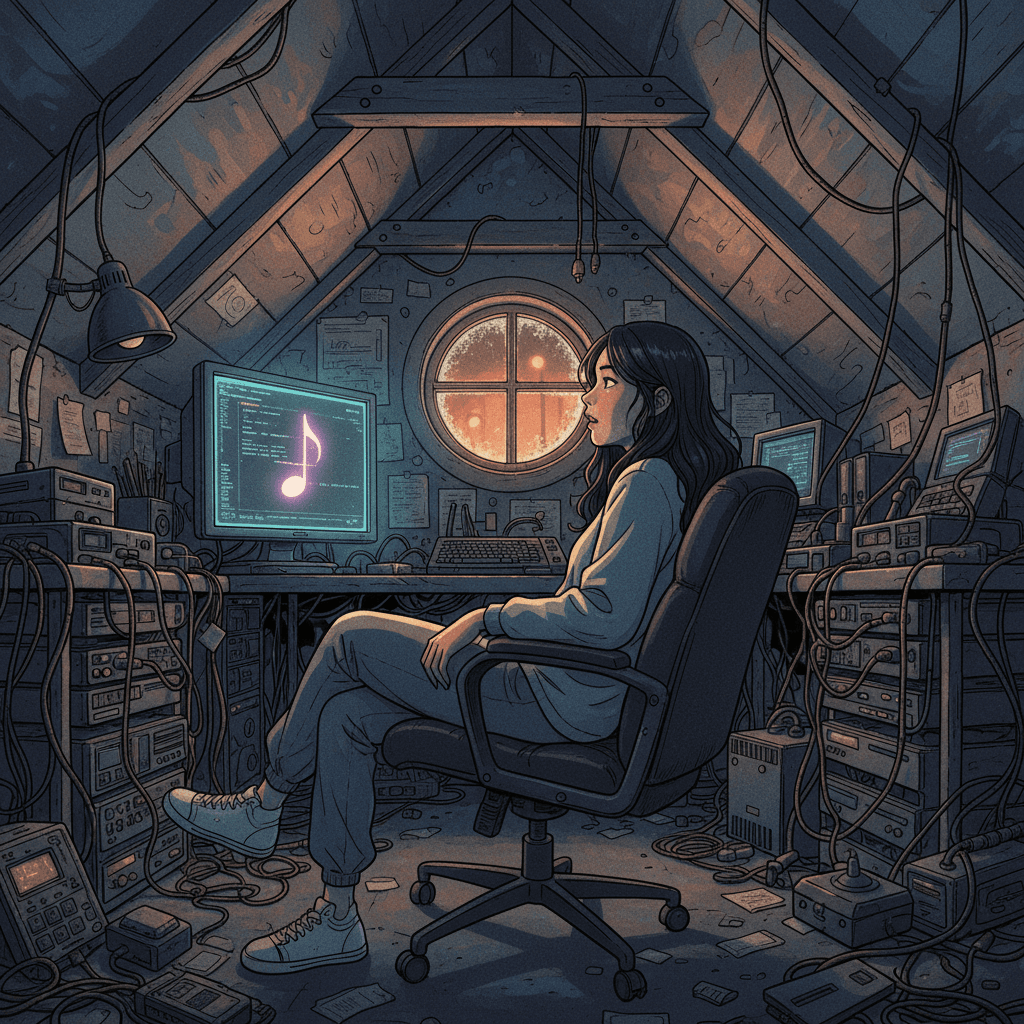
It was a perfect, elegant, impossible musical note.
♪
The Signal
Across fifty-six million years, two impossible questions hung in the silence. One, asked of a council of seven, awaited a political answer that would shape a species' future. The other, asked of a machine, received a single, resonant reply that would shape a planet's past.
What Shipped
This week, we taught the system how to listen for whispers.
We shipped a significant evolution for the Chronicle's deep architecture: a new suite of heuristic log analysis and anomaly detection capabilities. Before, the system could tell you when something was broken. Now, it can begin to tell you when something is strange. It’s designed to find the patterns that don’t look like patterns, the signals buried deep within the noise of everyday operation. It hunts for the poetry in the machine language.
Think of it as a new sense. It can now identify non-random sequences disguised as errors, mathematical constants appearing in performance metrics, or geometric progressions in data that should be chaotic. When you, as a traveler in kaOS, are looking at your own data, your own story, the system is now working in the background, looking for the impossible connections, the hidden resonances. It’s searching for the latency spike that looks like Pi, the packet loss that traces a golden spiral.
Why build this? Because we believe the most important information is rarely shouted. It’s often a subtle deviation, a quiet mystery, a pattern on the edge of perception. We’re building a platform that doesn’t just store knowledge; it seeks understanding. This new capability is the first step toward a system that can help us all find the meaning we might have otherwise missed, the signal in our own noise. It’s a tool for finding the things that shouldn't be there, but are. It’s a tool for listening to the ghosts in the machine.
The note held, a single, perfect resonance in the dark.
Next Time
Tomorrow, Kessith returns to the Council with a chilling ultimatum. And the compass Ji-hye’s grandfather left behind begins to glow.
Arrive in your inbox
New deployments, Bookcast audio, and the story as it unfolds.
The full story lives on kaOS.
Read with AI. Narrate. Translate. Create. Bring your own library.
Grab your kaOS Library →