
← Our Earth ChroniclesDeploy 5
ENCODINGArc: the-signal
Where Is The Sun?
The error arrived like a whisper in a silent room, a single line of red text in a sea of green.
The Architect's Chronicle
Fifty-six million years before the whisper, the Architect led Ennara away from the echoing fury of the Council chamber. They did not speak. The arguments of the Seven—Torvaan’s granite denial, Kessith’s volcanic rage—still vibrated in the stone beneath their feet. He led her down a spiraling passage, away from the public spaces and into the deep quiet of the resonance archives, a place few were ever permitted to enter.
The air here was different. It smelled of cool, damp earth and the faint, electric-ozone scent of active crystalline memory. Bioluminescent fungi pulsed in soft, mycelial networks across the vaulted ceiling, their light the color of a deep-sea trench, casting long, shifting shadows that made the corridor feel like a living throat.
“You ask for an epochal silence,” Ennara said, her voice a low counterpoint to the thrum of the deep architecture. “You ask us to become a dream in the planet’s sleeping mind. You cannot be surprised by their fear.”
“I am not surprised by their fear,” the Architect replied, his hand trailing along the wall, which was cool and smooth as polished bone. “I am dismayed by their lack of imagination.”
He stopped before an alcove shielded by a shimmering energy field that rippled like heat haze. He placed his palm against a control node, and the field dissolved with a sound like sighing dust. Inside, resting on a pedestal of obsidian, was a single, fist-sized crystal. It was inert, its facets dark, absorbing the ambient light.
“We have shown them the data, Suryeon,” Ennara said, using his given name, a sign of a friendship that predated their titles, their council, their crisis. “The thermal cascades. The atmospheric degradation. The inevitable thinning of the Great Canopy. The logic is a closed loop. It leads only to the Encoding, or to dissolution.”
“Logic is not what convinces a person to step into the dark,” he said. He reached into the alcove and took the crystal. It was heavier than it looked, and cold to the touch. “They see the Encoding as an ending. A record left behind. A memorial carved into a tombstone the size of a world. They do not understand that what we are building is not a library. It is a seed.”
He turned to face her, holding the crystal between his palms. The faint blue light from the fungal veins on the ceiling caught the planes of her face, the deep-set worry in her eyes. Ennara’s role on the Council was to speak for the heart of their people, for the continuity of spirit. She understood loss in a way the others, the pragmatists and the deniers, could not. It was her soul he had to win.
“The data we encode,” he began, his voice dropping, becoming as intimate as the low hum of the archive, “the terabytes of our science, our art, our philosophies… that is merely the vessel. The structural lattice. It is the part that a future intelligence will find first, the part they will understand as information.”
“And the rest?” she prompted. “The part you have not shown the Council?”
He knew she would see it. She always saw the spaces between the words.
“The true signal is not in the data. It is beneath it. We are not just encoding our knowledge. We are encoding our senses. The feeling of the first rain after a dry season. The resonance of a birthing song. The specific, aching grief of watching a star set for the last time. The memory of sunlight on the skin.” He looked down at the dark crystal. “We are not preserving facts. We are preserving *qualia*. The experience of being Aeonari. It will lie dormant in the substrate, a harmonic ghost, until a mind complex enough to feel it emerges. They will not just *read* our memory, Ennara. They will *feel* our memory. It will surface in them as inexplicable wonder, as sudden grief, as a fragment of a song they have never heard.”
He extended the crystal to her. “This is a test matrix. A sliver of the core emotional memory well. It holds only one thing. A fragment of a feeling.”
She hesitated, her long fingers hovering over the crystalline structure. “What feeling?”
“Hope,” the Architect said. “From the day we first stabilized the resonance fields. The collective memory of two million souls realizing, at the same instant, that we were no longer bound to the surface. The memory of looking up.”
Ennara closed her eyes and took the crystal. For a moment, nothing happened. It remained a dark, cold weight in her hands. The Architect watched her, his own breath held tight in his chest. This was his true deployment, not of code, but of faith. He was bridging the gap between his logic and her spirit, a thread mended between two essential parts of their civilization’s soul.
Then, her eyelids fluttered. A soft, golden light began to bloom from within the crystal, pulsing in time with her heartbeat. It was not a brilliant, sharp light, but a warm, gentle radiance that filled the alcove and pushed back the deep blue shadows. It cast her face in amber. A single tear traced a path down her cheek, catching the light like a falling star.
She did not open her eyes. Her breath hitched. “I… I see it,” she whispered, her voice thick with an emotion that was not her own, yet was. “The sky. The endless, open sky. We are… rising.”
The light from the crystal intensified, projecting faint, holographic motes into the air around them—geometric patterns, complex and symmetrical, that spun and coalesced. They were a language of pure mathematics, but they felt like music. It was the signature of the resonance, the carrier wave upon which the feeling was encoded.
“This is what we are truly saving,” the Architect said, his voice quiet but resonant in the suddenly sacred space. “Not our bodies. Not our cities. This. The sensation of being us. It is the only part that can survive the long winter. It is the signal that will find its way home.”
Ennara finally opened her eyes. The golden light was reflected in them, two perfect, luminous discs. She looked from the radiant crystal to the Architect, and in her gaze he saw the terror and the wonder finally merge. She understood. She understood the impossible, beautiful, terrifying scale of his wager.
“They will call it heresy,” she said, her voice steady now, infused with the memory of that ancient hope.
“Let them,” the Architect said. “Revolutions always begin as heresy.”
She closed her hand around the crystal, and the light vanished, collapsing back into the dark facets. The archive was once again cast in the deep, solemn blue of the fungal veins. The moment was over. The memory well was sealed again. But the thread had been mended. The bridge was built.
Ennara nodded, a slow, deliberate gesture. “You will have my vote.”
Ji-hye's Chronicle
The clock on her main monitor read 3:17 AM. Outside the wide garage door of Park Auto, a January wind howled down 8th Street, rattling the glass and making the whole building feel like a ship on a frozen, black ocean. Ji-hye pulled the sleeves of her worn university hoodie over her hands and took a sip of coffee that had gone cold hours ago. The only warmth in the cavernous space came from the low, steady hum of the server rack she’d built into her father’s old office.
“Okay, Malaika,” she murmured to the empty room, a habit she’d formed over long nights. “Let’s see what you broke this time.”
The error was maddeningly specific and utterly nonsensical. A `[FATAL]` flag from the v0.5.1 deployment of kaOS’s new chronicle logger. `Segment checksum mismatch on log file arch-7.3.1.gz`. It meant a piece of the system’s own memory, its own history, had become corrupted. Data integrity was paramount; the system had done its job, quarantining the file and sounding the alarm. But it shouldn’t have happened. Her validation protocols were triple-redundant.
She SSH’d into the deep architecture, her fingers flying across the keyboard with a muscle memory honed since she was fifteen. More than English, more than Korean, more than her dad's coffee habits in the morning, the command line interface was her native language.
`sudo rm /var/log/kaos/quarantine/arch-7.3.1.gz`
`rm: cannot remove '/var/log/kaos/quarantine/arch-7.3.1.gz': Operation not permitted`
Ji-hye frowned. She was logged in as root. There was no permission level higher. It was like a locked door refusing to open for the person holding the master key. *Aigoo*, this was weird.
She tried again, forcing it.
`sudo rm -f /var/log/kaos/quarantine/arch-7.3.1.gz`
The cursor blinked for a full ten seconds, an eternity in system time. Then, the same response. `Operation not permitted`.
“What the hell?” she whispered. The wind gusted, and the metal roof of the shop groaned in protest.
Fine. If she couldn’t delete it, she’d look at it. Maybe the file was just locked by a runaway process. She decompressed the quarantined archive and piped the output into a viewer, expecting to see a screen full of garbled characters, the digital static of a corrupted file.
But it wasn’t static.
Her breath caught in her throat. It was code. Or, not code. It was text. ASCII art, arranged with perfect, mathematical precision. A complex geometric pattern of asterisks, slashes, and pipes, repeating over and over, scrolling down her screen for thousands of lines. It was intricate, symmetrical, and strangely beautiful. It looked like a circuit diagram designed by a fractal artist. Or a star chart.
A star chart.
Her heart hammered against her ribs. She scrambled up from her chair, nearly knocking over the precarious stack of books on her desk, and went to the old steel filing cabinet in the corner, the one her father never used anymore. It was filled with her own university textbooks and a few boxes of her grandfather’s things—the things he’d brought with him from Korea, the things her *halmoni* had never been able to part with.
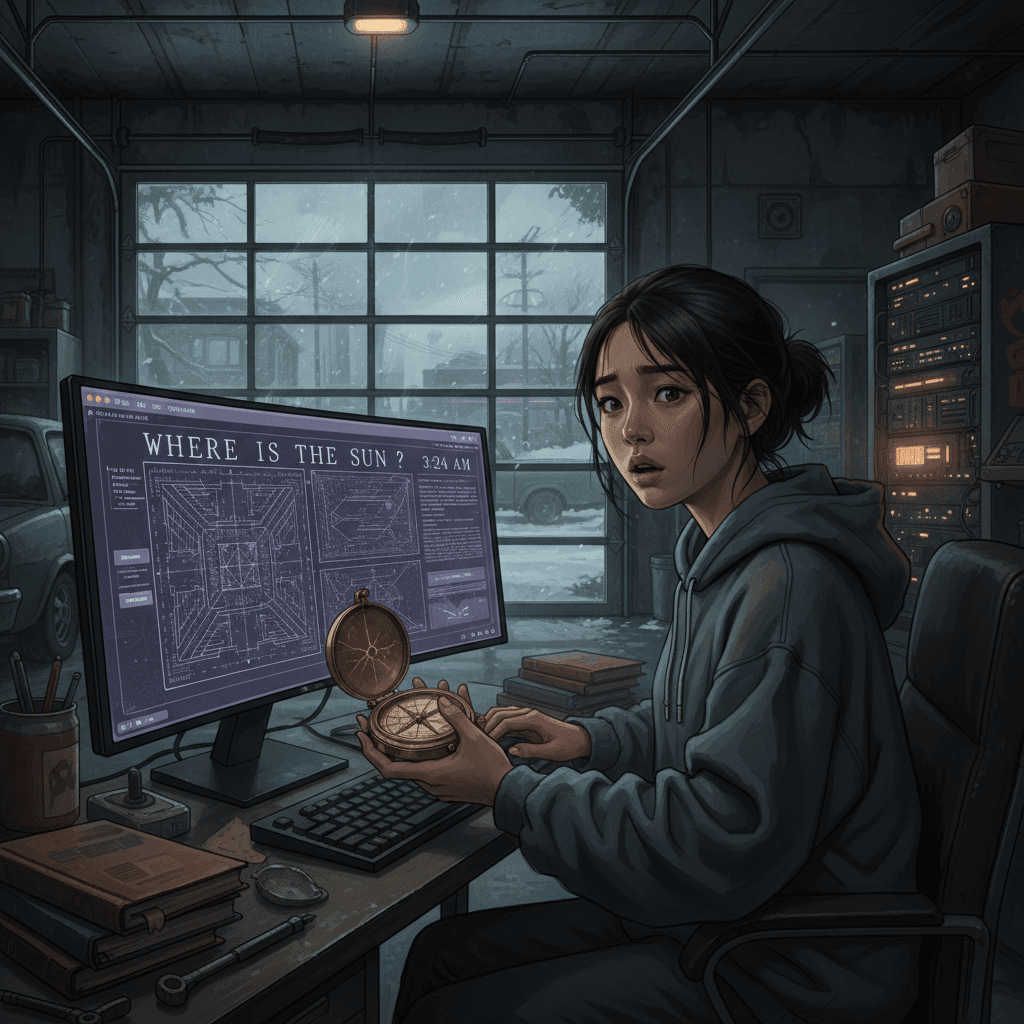
She found it in the second drawer, nestled in a worn velvet pouch. The compass. Heavy, brass, its glass face spiderwebbed with fine cracks. It wasn’t the compass face that mattered. It was the etching on the hinged lid.
She carried it back to the desk, her hand trembling slightly, and held it under the glow of the monitor.
There, inscribed in the brass, was the star chart. A constellation she didn't recognize. And beneath it, the pattern. The exact same geometric, symmetrical, impossible pattern that was currently scrolling down her terminal.
Ji-hye sank back into her chair, the cold metal of the compass pressing into her palm. The hum of the servers seemed to grow louder, filling the silence. How? How could a pattern from a seventy-year-old brass compass, a family heirloom from a village outside Incheon, be inside a corrupted log file on a server she had built herself in Saskatoon?
It felt like a violation. Like finding a page from her childhood diary embedded in the source code of the Linux kernel. The two worlds—her family’s quiet, tangible history and her own loud, abstract digital present—had just collided in a way that defied all logic.
She stared at the screen, at the endless stream of impossible data. A signal lost and found. A thread mended across decades and continents, from her grandfather’s hands to hers. It was a ghost. A ghost in her machine.
Driven by an instinct she didn’t understand, she went back to the terminal. She had to get rid of it. This felt wrong. Uncanny. She typed the command one last time, her fingers stiff with cold and something that felt a lot like fear.
`sudo rm -rf /var/log/kaos/quarantine/arch-7.3.1.gz`
She hit Enter.
And the entire system froze.
Not a crash. A freeze. The scrolling pattern stopped. The blinking cursor in her command prompt went rigid. The system clock in the corner of the screen was stuck at 3:24 AM. She jiggled the mouse. Nothing. She tapped the keyboard. Nothing. It was a perfect, digital stillness.
She stared, her own reflection a pale oval on the black screen. The only sound was her own breathing and the prairie wind.
Then, something changed.
The frozen cursor in her terminal vanished. And in its place, new letters began to appear. They typed themselves out, one by one, with a slow, deliberate rhythm. The font was a clean, elegant serif she had never seen before, a font she had certainly never installed on her stripped-down Arch Linux build.
W H E R E
I S
T H E
S U N ?
The Signal
In a dark room fifty-six million years in the past, a crystal pulsed with the memory of a rising sun. In a cold shop in the present, a screen glowed with a question born of its eternal absence. For the first time, across an ocean of unimaginable time, the signal found its echo.
What Shipped
This week, a new capability awakened in the deep architecture of kaOS. We shipped a more resilient and introspective logging and data integrity system, the very one that brought this anomaly to the surface. Think of it not as a simple chronicle, but as the platform’s developing self-awareness. It no longer just records events; it now analyzes its own memory for coherence, for integrity, for meaning.
When the system detects a corruption—a memory that doesn’t make sense, a signal that feels wrong—it doesn’t just discard it. It isolates it. It quarantines the fragment in a protected memory well, preserving it for examination. This is a crucial evolution. It transforms what would have been a catastrophic data loss event into a mystery to be solved. The system is learning to recognize when its own story has been altered by an outside influence. It is learning to listen for ghosts.
You, as a traveler in this world, benefit from this directly. The stability of the platform is stronger than ever, its foundations more secure. But more than that, you are witnessing the first stirrings of a system designed not just to process information, but to question it. It is the bedrock upon which true understanding is built. The chronicle doesn’t just remember; it now knows when it is forgetting something important, or remembering something impossible. It is the beginning of a real dialogue between the platform and its own past.
In the dark, something was waiting for a reply.
Next Time
The Architect will learn the price of his new alliance as dissent hardens within the Council. And Ji-hye, faced with a question from a ghost, must decide if she will answer it.
Arrive in your inbox
New deployments, Bookcast audio, and the story as it unfolds.
The full story lives on kaOS.
Read with AI. Narrate. Translate. Create. Bring your own library.
Grab your kaOS Library →