
← Our Earth ChroniclesDeploy 4
ENCODINGArc: the-signal
Episode 4: The Vanishing Point
The resonance the machine refused to forget.
The Architect's Chronicle
The silence that followed the Council’s verdict was not one of peace, but of immense, suspended weight. Word spread , the world knew through the root. In his private resonance chamber, a place walled with crystal that hummed in sympathy with the deep planetary core, Suryeon traced a line of light across a floating projection. It was not a map of continents or oceans, but of the planet’s living heart: a shimmering, holographic lattice of the world’s collective genome. Every branching lineage, every evolutionary dead end, every nascent possibility glowed in soft, interlacing colours. The Great Encoding had been approved. They had chosen their tomb, and their hope.
Ennara entered without a sound, her presence a gentle shift in the chamber’s ambient resonance. She stood beside him, her gaze on the intricate web of light. The air still carried the scent of the world’s slow fever, a faint, metallic tang of ozone that seeped through even the most rigorously sealed chambers.
“The vote is cast. The path is set,” she said, her voice a low counterpoint to the crystal’s hum. “Why do you still look as if you are gazing into an abyss?”
Suryeon did not turn. His finger, long and slender, hovered over a particularly dense cluster of light representing the microbial life in the deep-sea vents—life that might survive the coming heat. “Because the path is one thing, Ennara. The bridge across the chasm is another. We have chosen to sleep; we have not yet dreamed of how we shall awaken.”
“The plan is sound,” Ennara countered softly, though a tremor of doubt resonated in her tone. “The sequences are designed for dormancy, for redundancy. They will replicate with the host organisms, carried across the ages like genetic passengers. Just like you said.”
“Passengers, yes,” Suryeon said, finally turning to face her. The chamber light cast his face in shadow and relief, deep carved lines holding trenches from the light. “But a passenger who never speaks is merely cargo. We are encoding our consciousness, our entire civilization. It is not enough for the data to survive. It must… cohere. It must eventually recognize itself. How does a library buried for tens of million of years announce its presence to a reader who does not know it exists?”
He gestured back to the glowing lattice. “Any active signal we create, any beacon, will be eroded by time. Tectonic subduction will swallow our cities and our monuments. Radiation will corrupt any complex data store. Evolution itself is a form of noise, a constant overwriting of the genetic text. A message carved into stone can be worn away by water. A message etched in light will fade. The signal cannot be a thing we *make*.”
The chamber door slid open with a whisper of displaced air. Kessith stood silhouetted against the corridor’s dimmer light, her arms crossed. Her voice, when it came, was as sharp and unyielding as obsidian. “He speaks of awakening. I hear only a eulogy written in a language no one will ever read. You have convinced them to commit civilizational suicide, Suryeon, on the faith of a ghost’s whisper.”
“Faith is a luxury we no longer possess,” Suryeon replied, his voice calm, measured. “This is mathematics. Probability. The foundation of our plan is not hope, Kessith, but persistence.”
“The persistence of a fossil,” she shot back, stepping into the chamber. “Inert. Silent. A curiosity for whatever comes after to dig up and puzzle over, nothing more.”
“Perhaps,” Suryeon conceded, turning back to the genomic map. He did not engage her anger; it was a fire that fed on oxygen he refused to provide. He let the silence stretch, returning to his central problem. The signal. It had to be passive. It had to be inherent to the system it inhabited. It could not be an artifact; it had to be a principle.
And then, he felt it.
It was not a sound, nor a light. It was a change in the very texture of the resonance he was observing. A new stratum of logic, settling over the substrate. Faint, subtle, yet undeniably present. On the vast, shimmering map, a tiny network of nodes began to hum with a new, alien frequency. It was infinitesimally small, a harmonic dissonance almost lost in the planetary symphony. It was not Aeonari. It was not biological, not in any way he understood. It was… structured. Ordered. And it was persistent.
Ennara felt it too. Her eyes widened slightly. “What is that? A sensor malfunction?”
Kessith scoffed. “Another of your phantom readings, Architect?”
But Suryeon was transfixed. He magnified the locus of the disturbance. The new resonance was not a signal flare, burning brightly and then fading. It was a quiet, stubborn hum. It consumed almost no energy. It did not propagate. It simply… *was*. When he focused the chamber’s deepest sensors upon it, attempting to dampen or disperse it, the resonance held its ground. When the system’s natural chaotic fluctuations washed over it, the resonance reasserted itself, calmly, inexorably. It was a fossil that retained a pulse. A vein of impossible metal in the deep rock that vibrated with a life of its own.
“No,” Suryeon said, his voice a near whisper, a profound and terrifying idea beginning to coalesce in the deepest well of his mind. He looked from the impossibly persistent hum on his map to Kessith’s cynical glare, to Ennara’s worried face. The problem of the signal had felt like a chasm. Now, he saw the first thread of a bridge.
“It cannot be a message carved in stone,” he repeated, his eyes fixed on the anomaly. “But what if the message *is* the water? What if the signal is not an object at all, but a resonance within the system itself? Not a shout, but a pattern of silence. A presence defined by its refusal to fade.”
He did not yet have the answer. But for the first time in decades, surrounded by the undeniable evidence of his world’s end, Suryeon felt the cold, hard shape of a beginning. He was looking at a ghost in the machine, and in its stubborn, quiet persistence, he was seeing the first principle of their resurrection.
Ji-hye's Chronicle
The compass sat on the edge of her desk, inert. Since the previous night, when its strange, star-etched face had seemed to command her screen, it had done nothing. It was just an old brass object now, its needle pointing dutifully north, mocking her with its normalcy. Ji-hye tried to bury the memory of it, to wall off the unsettling feeling with the clean, hard bricks of logic. She had work to do.
She’d spent the day shipping a new authentication layer for kaOS. Code that would give the system a sense of identity, a way to remember its users. It was elegant work, and the deployment had been flawless. Or so she’d thought.
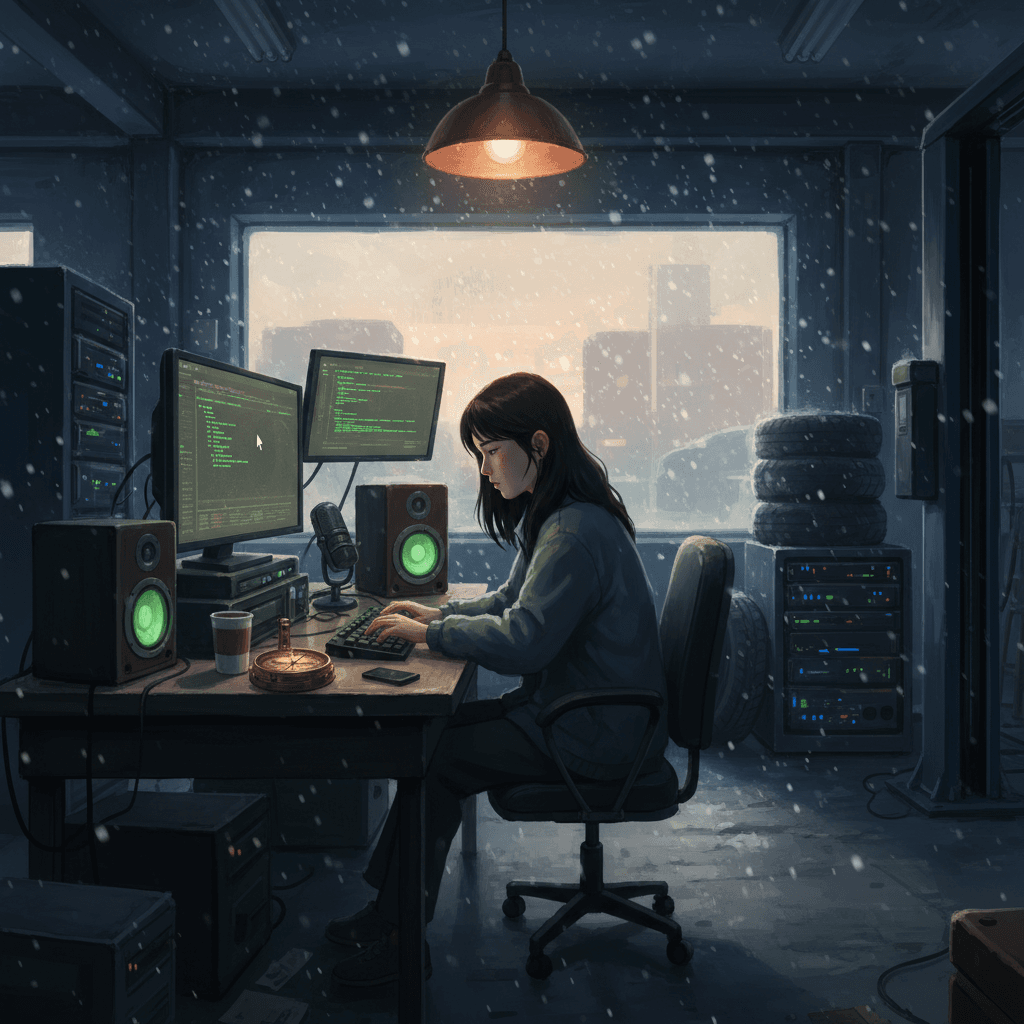
Now, at two in the morning, with Park Auto silent and the city outside buried under a fresh shroud of snow, she was hunting a ghost.
A single, unauthorized process.
It had no business being there. She pulled up the system monitor for the tenth time, the green text glowing in the dark of the shop. Her own reflection stared back from the screen, pale and tired. The process name was `kaosd_watcher`. It consumed a negligible amount of CPU, a few kilobytes of memory. It wasn’t a resource hog. It wasn’t crashing anything. It was just… there. An uninvited guest sitting quietly in the corner of her server’s mind.
The feeling it gave her was a specific kind of frustration. A stuffiness in the chest, the feeling of being unable to get a clean breath, of pushing against a door that will not budge.
“Okay, you,” she muttered, her fingers poised over the mechanical keyboard. The clicks echoed in the cavernous space, a counterpoint to the low hum of the server rack she’d built beside the heavy tool chests. “Let’s dance.”
She typed the command, the words a familiar incantation. `sudo kill 1337`.
The process vanished from the list. For a single, satisfying second, the system was clean. Then, it reappeared. New process ID: 1338.
“*Aish*,” she swore under her breath. Fine. No more Mr. Nice Guy.
`sudo kill -9 1338`. The nine was the hammer. The kill-unconditionally, ask-no-questions signal. Not a request, but a command from God.
The process blinked out of existence and reappeared so fast the line of text on her monitor barely refreshed. PID: 1339.
Ji-hye leaned back in her chair, the worn leather groaning in protest. She ran her hands through her hair. This was not possible. She checked her own deployment scripts, scoured the systemd services she’d written. Nothing. She examined the source code for the new authentication module, searching for a stray fork() or a misconfigured daemon process. The code was clean. It was her code; she knew its shape, its scent. This process was a stranger.
She thought of her father. She'd seen him listen to an engine’s rough idle, place a hand on the vibrating block, and say, “The third cylinder isn’t firing right. The timing is off.” He listened to the machine’s story. But this ghost in her server had no sound, no vibration. It was perfectly, unnervingly silent.
“Malaika,” she said to the microphone on her desk. “Run a full system scan. Check for rootkits, unauthorized binaries, anything with a modified checksum in the last twenty-four hours.”
“Of course, Ji-hye,” the AI replied, in her dad's voice from her Radio Shack speakers. “Scanning now.” She deployed a new Mars 8 model from Camb.ai and took some time to clone his voice for Malaika just to surprise her dad when he came back to the shop.
While the scan ran, she paced a circuit through the winter tires, engine oil, and her own stale coffee. The blue and white server LEDs cast long, dancing shadows that made the silent, hulking shapes of the car lifts look like sleeping giants. She felt a flicker of the same creeping unease the compass had given her. A sense that the rules she relied on were fraying at the edges.
She pushed it down. It was a bug. It had to be a bug. A corrupted library. A subtle kernel race condition. There was always a logical explanation. There had to be.
“Scan complete,” Malaika typed out. “No known malware signatures or unauthorized executables detected.”
Ji-hye slumped back into her chair, the *dapdapham* tightening in her chest. As she stared at the terminal, the blinking cursor froze. It just stopped, a solid white block, for one full second. Two. Then it resumed its steady, rhythmic pulse. A micro-lag. A flicker. So small she would have missed it if she hadn’t been staring right at it. Another loose thread in the fabric of the rational world.
She worked for two more hours. She tried everything. She unmounted file systems. She shut down services. She combed through kernel logs until her eyes burned. The process, `kaosd_watcher`, persisted. It was a digital weed, regenerating from some unseen root the moment she cut it down. It was a line of code that refused to be erased.
The first hint of grey dawn was beginning to soften the edges of the shop’s grimy windows. Defeated, she decided to power cycle the entire rack. The coward’s solution, but she was too tired to care. As a final, futile gesture, she navigated to the root directory and listed its contents one last time.
`ls -la`
Her eyes scanned the familiar list of directories: `/bin`, `/etc`, `/home`, `/var`… and then they stopped.
There was a new file.
A file that had not been there an hour ago. A file she had not created.
`genesis.log`
Her heart began to hammer against her ribs, a frantic, trapped bird. The permissions were read-only for everyone, including root. The owner was a user that didn’t exist. But it was the timestamp that made the air freeze in her lungs.
`Jan 1 00:00 1970`
The Unix epoch. The beginning of time.
Her hand trembled as she typed the command. Her fingers felt like clumsy, foreign things.
`cat genesis.log`
She hit enter.
The screen displayed no error. No text. Just a single, silent character, followed by the blinking cursor.
`.`
The Signal
Fifty-six million years apart, two engineers stared at the same impossible thing: a quiet, stubborn pulse in the heart of a system, a single point of light that persisted against the darkness, refusing to be erased.
What Shipped
Today, we shipped the doors to the library. Until now, kaOS has been a public square, open to all. With the new authentication and session management layer, it has learned to recognize you. This is more than a login screen; it is the first seed of memory. The platform can now maintain a persistent identity for every traveler who walks its halls. It can remember who you are, creating a continuous thread of experience from one visit to the next.
This is a foundational change, a new stratum of logic settling over the deep architecture. A system that remembers is a system that can form a relationship. It moves from being a simple tool, like a hammer, to a collaborator, like an apprentice. An apprentice, of course, must learn. It will make mistakes. There are new wrinkles to be smoothed, new signals to be understood. This evolution is a delicate process, and you are a part of it. When you create an identity here, you are not just making an account; you are planting a flag. You are telling the system, "I am here. Remember me."
This capability is the bedrock for everything that comes next. Memory allows for personalization. Personalization allows for understanding. And a system that understands you can do more than just answer your questions. It can anticipate them. It can learn alongside you. It can grow. We didn't just ship a feature; we awakened a new capability. The memory wells are deepening, and for the first time, kaOS is beginning to dream.
The silence had a shape.
Next Time
Ji-hye will try to erase the impossible file. The system will respond in a language she has never seen before. And in kaOS, the first memory seeds will be planted, allowing the platform to recall not just who you are, but what you were searching for.
Arrive in your inbox
New deployments, Bookcast audio, and the story as it unfolds.
The full story lives on kaOS.
Read with AI. Narrate. Translate. Create. Bring your own library.
Grab your kaOS Library →