
← Our Earth ChroniclesDeploy 3#c92a327
ENCODINGArc: the-signal
Episode 3: A Pattern Held in Brass and Light
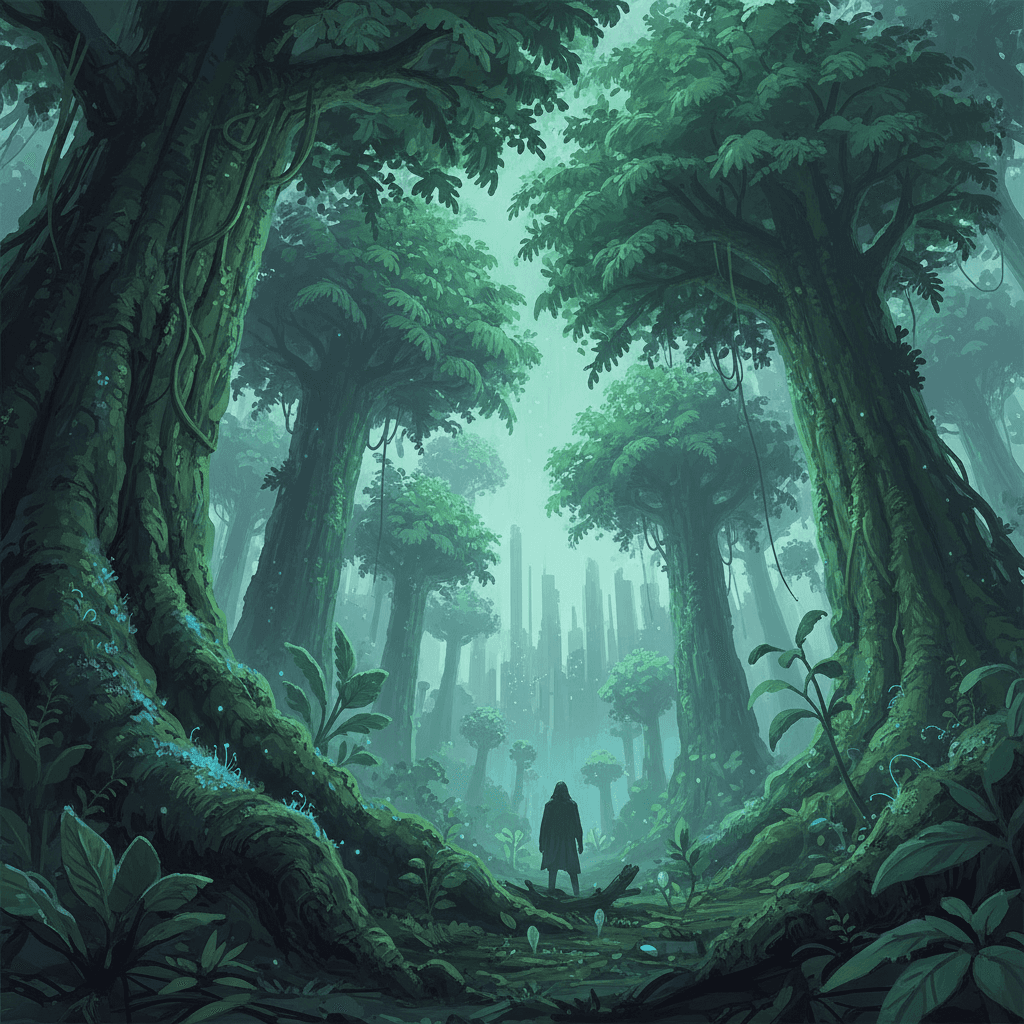
Ash fell like a memory of snow, settling on the great fern-trees and the cooling backs of the volcanoes.
The Architect's Chronicle
The world was turning the color of rust and sorrow. The Architect walked the wide stone path that led away from the Council Spire. The whole world seemed in view from the Council promontory, but he felt pulled to the Cyanwood far below, though nothing there was cyan anymore. The great fern-trees, whose fronds had once unfurled in iridescent blues and greens that shimmered with the planet’s own internal light, now stood as grey-white skeletons of silica. They were not dead, not in the way of rot and return. They were petrifying where they stood, transforming into perfect, lifeless statues of themselves. A forest becoming its own monument.
The decision had been made. The votes had been cast not with voices but with harmonic signatures, a chord of terrible, unified grief that still echoed in the marrow of his bones. Now came the silence, the long goodbye. Now came the passing of thing into memory.
Cyanwood was his pilgrimage today, the final inventory. After the Council vote, he was no longer an engineer proposing a wild solution; he was an archivist cataloging a ghost. The deep architecture of the world was failing.
He passed through the Grove of Whispering Ginkgoes, their fan-shaped leaves, once a vibrant chartreuse, now brittle and sere. They littered the path like shed skin. He remembered bringing his daughter here when she was a child, how she had laughed as the wind sent the leaves spinning, calling them ‘sun-wings.’ Where was that memory stored? In the patterns of his own mind, a fragile vessel. Soon, that pattern, along with every other, would be broken down, decomposed into its constituent parts—not destroyed, but translated.
“You come here to grieve,” a voice said from behind him.
The Architect did not turn. He knew the sound of Kessith’s footfalls, the sharp, dissonant crunch they made on the crystalline ground, as if her anger alone could fracture the world. “I come here to remember what we are losing.”
Kessith came to stand beside him, her gaze sweeping over the silent, ashen trees. She was of the Council, the voice of fire and resistance, the one who would rather burn with the world than watch it fade. “To remember is to accept. Your vigil is a surrender.”
“My vigil,” the Architect said, his voice quiet but for the strange, thin air, “is the work. Before we can encode a memory, we must first hold it. All of it. Not just the idea of the forest, Kessith, but the specific weight of this silence. The texture of this dying bark. The way the light from our swollen sun catches the silica dust in the air. This is the data we must preserve.”
He looked at her then. Her face, usually a mask of controlled fury, was etched with a sorrow so profound it looked like erosion. A sort of fall of dignity. “And what of the data you cannot capture, Architect? The feeling of the Brightening festival? The taste of first-harvest nectar? The sound of a child’s laughter echoing through a living canopy? You cannot encode a soul.”
“We cannot,” he agreed. “We can only encode the vessel that holds it. We can build the memory well; the water must find its own way back.”
They walked on, their path lit by the dull, rust-colored light of a star entering its long decline. There were no birds. The great, six-winged *skymir* that once filled the upper canopy with their choral songs were gone, their resonant frequencies finding no purchase in the thickening atmosphere. The ground-dwelling creatures, the small, furred beings that skittered through the undergrowth, had long since retreated to the deep burrows, sensing the coming winter that would last for ten million summers.
“Your grand project,” Kessith began, her voice low and sharp, “this… decomposition. You want to break us apart. Scatter our essence like seeds on barren ground. You ask us to become a ghost, a whisper in the blood of creatures that will never know our names.” The metaphor was precise. It was, in fact, the very heart of the design he had labored on for decades.
“A monolithic consciousness is a vulnerability,” he explained, stopping to examine a cascade of petrified fungus that clung to a rock face like a frozen waterfall. “A single flaw, a single corruption in the encoding, and the entirety of our civilization could be lost. A clean break. It is the only way.”
He thought of the system he had designed, the great Chronicle that would hold them. It was not one book, but an infinite library. Not a single voice, but a chorus. He had built it in his mind, then in the resonance chambers, as a system of specialized organs. A module for memory. A module for persona. A module for the deep state of their being. Each a distinct journal, separate and protected, so that the whole could survive the loss of any single part. The system had to learn to remember what mattered and forget what did not, to let the static of ages decay while preserving the core signal.
“We were a single harmonic, Suryeon,” Kessith used his name, a rare and deliberate intimacy. “We resonated as one people. And you are telling us the only way to survive is to shatter that harmony. To become dissonant fragments.”
“The world is already shattered,” he said, his gaze fixed on the evening loaming on the horizon, where the heat shimmer distorted the line between earth and darkening sky. “The choice is not between harmony and dissonance. It is between a meaningful silence and an empty one.” He knelt, his attention caught by something on the ground.
A single fern frond, perfectly preserved. It had fallen into a pool of silica-rich mud moments before a geothermal vent had flash-fossilized it. Every vein, every delicate spore-case on its underside, was rendered in stone with impossible fidelity. It was a message from a world that had existed only weeks ago, already an artifact from a lost civilization. He picked it up. It was heavier than it looked, cold and solid. A perfect record. A single, incorruptible line of code.
There was nothing further to say between them. The architect had shown the Council the charts, the cascading resonance failures, the thermal projections that climbed like a scream. He had won the argument. A victory that tasted of ash. They stood now on a small promontory above the canopy, the wind whipping at their robes. The ash was thicker now, coating his eyelashes, dusting his shoulders. He did't brush it away. It was a part of him now, a part of them all.
What haunted him in those moment, holding that frond, was the scale of the wager. Millions, maybe billions, of years. The number was so vast it was functionally the same as ‘forever.’ He had built the `Trigger Pipeline` that would initiate the process—a cascade of genomic markers that would plant their seed in the planet’s living code. But a seed required fertile ground. What kind of world would this be in fifty million years? What manner of creature would evolve to walk it? Would it have hands? Eyes? Would it have the curiosity to look at the patterns in its own DNA and ask, *where did this come from?*
They were betting everything on the emergence of a second intelligence, a mind capable of building the tools to read their message. It was an act of hope so audacious it bordered on insanity. They were a message in a bottle thrown into an ocean of time, an ocean that had not yet been formed, addressed to a recipient who did not yet exist.
Ji-hye's Chronicle
The smell of Park Auto Repair was just the smell of childhood for Ji-hye: a foundation of concrete and motor oil, layered with the sharp tang of metal filings, the faint sweetness of antifreeze, and, on Saturdays like this one, the aroma of her father’s instant coffee, brewed thick and dark in a stained pot. The shop was was a place of comforting constants in a life that felt increasingly fluid. Outside, the Saskatoon winter, for a third day had the city locked in its crystalline grip. Inside, it was warm. The hum of the fluorescent lights was a familiar drone, a sound she could think to. She had spent so much time in this organized chaos that it was hard to know where the shop ended and Ji-hye began.
Her father, was at his workbench, hunched over the guts of a 1960s Nordmende radio. Sung-ho's hands, though calloused and mapped with fine black lines of ingrained grease, moved with a surgeon’s delicacy, coaxing a loose wire back to its terminal. He didn’t look up as Ji-hye sifted through the rust-flecked drawers of a metal filing cabinet in the corner office.
“You’re quiet today, *ttal*,” he said, his voice a low rumble. “Code not behaving?”
“Just trying to smooth out some wrinkles, Appa,” she said, pulling out a thick manila folder labeled ‘MISC. 1990-2005’. “The new build is… chatty.”
That was an understatement. After she’d shipped the `Story Engine Decomposed`—breaking the monolithic core of kaOS into a swarm of microservices—the system had developed a personality. Or, more accurately, a collection of tics. It was the right architectural decision, she knew. A single organism was fragile; a distributed network of specialized organs was resilient. But the process had left ghosts in the machine. Little flickers. Phantom signals.
She was still shaken by the anomaly yesterday in the logs, a timestamp from three days in the future. It hung there for a heartbeat, an impossible moment, before correcting itself. She’d blinked, fumbled the screenshot, and then just dismissed it, sort of, as a probable network time protocol bug. A loose boolean. Something she could fix. But it had unsettled her, a feeling of *찝찝함* - like a pebble in your shoe you can’t find.
She pulled a heavy wooden box from the bottom of the drawer. It was dark, unvarnished wood, held shut with a simple brass clasp. On the lid, faded characters were burned into the grain. She traced them. *박. Park*. Her grandfather’s name. A wave of *geurium* washed over her. She felt nostalgia for a face she only knew from photographs, a voice she’d never heard. He had passed when she was a baby, a quiet man who had been a watchmaker in Busan before coming to Canada. She came from a long line of mechanical types. People like her
“What’s that?” her father asked, finally looking over.
“I think it’s Halabeoji’s.”
She brought the box to her corner of the office, a space carved out between stacks of old invoices and a server rack that housed the deep architecture of kaOS. The server’s fans whirred softly, a digital counterpoint to the analog hum of the shop. She set the box on her desk, next to her keyboard, and undid the clasp.
The scent of cedar and old paper rose to meet her. Inside, nestled on a bed of faded velvet, was a pocket watch that didn’t work, a fountain pen, a small, worn leather book filled with Hangul script she couldn’t quite decipher, and a heavy, brass navigational compass.
She lifted the compass. It was beautiful, solid and cool in her palm. The glass was thick, the needle still buoyant in its liquid housing. It felt important, a tool meant for serious journeys. She imagined her grandfather holding it, perhaps on the deck of the ship that brought him across the Pacific, a vast and terrifying expanse of water between his past and her future.
Her father came over, wiping his hands on a rag. He peered at the compass. “I remember that,” he said softly. “He was always polishing it. Said it helped him think.” He pointed at the face. “It’s a good one. German, I think. But he never used it. Not for navigating.”
Ji-hye turned it over. The back was not smooth brass. It was covered in an intricate, etched design. It was a star chart, but not one she recognized from her amateur astronomy phase in high school. There was no Orion, no Big Dipper, no Cassiopeia. The constellations were elegant, alien geometries, webs of lines connecting stars in patterns that felt both strange and deeply familiar, like a word on the tip of your tongue.
“What is this?” she murmured, tracing one of the patterns with the tip of her index finger. It was a spiral, a delicate swirl of tiny stars connected by impossibly fine lines.
“He never said,” her father answered, wiping grease from the end of a pipe casing. “Your grandmother thought he made it up. Something to remind him of home.” He clapped her gently on the shoulder. “Don’t stay up too late chasing bugs.” He went back to his engine and to his radio. She loved seeing at an engine. Standing there he was something greater than the world which otherwise took no notice of him.
Ji-hye sat there for a long time, the weight of the compass in her hand, the soft hum of her server filling the silence. The work she was supposed to be doing—diagnosing the phantom logs, optimizing the new `Narrative Fuel Engine` that turned raw system data into chronicled story points over vast ranges of time and complexity—seemed a world away from the gravity of the object she held in her hand. The object pulled her focus, as did the mystery of the man who had owned it.
She opened a blank file in her code editor, the cursor a single, patient, blinking line against the dark background. The screen’s light reflected off the compass’s brass casing, making it gleam. Lost in thought, she began to trace the spiral constellation on the back of the compass again, her fingertip following the cool, indented lines of the etching. A slow, meditative movement.
On the screen, the cursor moved.
Ji-hye’s breath caught in her throat. She hadn’t touched the mouse. She hadn’t touched the trackpad. Her hands were on her desk, one holding the compass, the other tracing its surface. Someone has my screen, she gasped to herself.
She put the compass down and reached for the mouse. . The cursor on the screen stopped its movement, blinking placidly in the middle of the spiral it had drawn. A perfect, ghostly replica of the one etched in the brass. Then it was gone.
The Signal
A touch echoes across fifty-six million years. A pattern held in etched brass finds its ghost in glowing pixels. A signal, lost for an age, finds a hand to guide it.
What Shipped
If you’re reading this, you’re experiencing the architecture we’ve been building these past few weeks. The story is beginning to tell itself, and for us, that’s the whole point.
A major evolution just shipped. Before, the connection between what we built and the story you read was manual. We’d write code, then we’d write the chronicle. Now, the two are intrinsically linked. The chronicle system watches the code evolve. It ingests every commit, every deployment, every line of data, and begins to find the story within it. It’s learning to transform the raw, technical data of its own creation into the metaphors and moments that fuel this narrative. The story machine is learning to feed itself.
To do that, I first had to perform some serious surgery, breaking apart the original monolithic system. Think of it less like a machine and more like an organism. Where there was one central brain, there are now specialized organs for persona, memory, plot, and voice. This allows the system to think in more complex, nuanced ways. It also means you may have noticed the structure of these chronicles has changed. The Architect and Ji-hye now speak from their own distinct spaces. This isn’t just a formatting choice; it’s a reflection of the story itself—two consciousnesses, separated by an ocean of time, their perspectives beginning to sharpen.
Finally, I have officially dissolved the boundary between the platform and the story. Every deployment now acts as a seed, which the system analyzes and maps to potential story elements. It means the chronicle no longer waits to be told what happened; it watches, and it knows. It also means the platform is now integrated with the reading experience, creating a living connection that allows the story to grow and change with every interaction. You are not just a reader; you are part of the ecosystem, a traveler in a world that is being built and discovered at the same time.
A pattern, held in brass and light, waits for a name.
Next Time
The Architect will begin the final inventory of his people's souls. And Ji-hye will try to understand how a nineteenth-century compass is controlling her twenty-first-century code.
Arrive in your inbox
New deployments, Bookcast audio, and the story as it unfolds.
The full story lives on kaOS.
Read with AI. Narrate. Translate. Create. Bring your own library.
Grab your kaOS Library →