
← Our Earth ChroniclesDeploy 2
ENCODINGArc: the-stones-memory
Episode 2: Our Memory Must Outlast The Stone
The stone remembers what the council cannot bear to say.
The Architect's Chronicle
Torvaan rose first, his ceremonial robes the color of volcanic ash. The bioluminescent walls dimmed as if flinching from his fury.
“Fifty million years,” he hissed, and the words fell like shattered obsidian on the stone floor. “You ask us to become ghosts in the machinery of our own planet. To dissolve ourselves into dirt and DNA, praying that some distant descendant stumbles upon our echo and has the decency to listen.”
The speaking stone vibrated beneath the Architect’s palms. He did not remove his hands.
Ennara, her fingers clasped in her lap as though cradling something fragile, spoke into the silence that followed. “What alternative remains, Torvaan? The surface will cook us. The deep earth will crush us. Your own thermal charts—”
“I know what my charts show!” Torvaan’s voice cracked against the chamber walls, and for a moment the bioluminescence flared bright amber — the color of alarm. “They show extinction either way. But at least extinction is honest. This — this scheme is a delusion spun from desperation. We would cease to be ourselves. We would become... what? Whispers in the blood of lizards?”
“Sequences,” the Architect said quietly. “Not whispers. Sequences. Precise, recoverable, complete.”
“Recoverable by whom?” Torvaan spread his arms wide, his shadow stretching across the carved alcoves. “By creatures that do not yet exist? By minds that may never evolve? You are asking us to stake everything — everything we are, everything we have built across ten thousand years — on a probability so thin it barely qualifies as hope.”
The chamber’s air had grown warmer. The Architect could feel it — a degree, perhaps two. The southern vents were closer than the models predicted.
Kessith, who had not spoken since the proposal, stirred in her alcove. She was the youngest of the Seven, and the most feared. When she spoke, her voice came from somewhere deep — not her throat but the chamber’s own resonance, as if the stone itself had found words.
“The children,” she said. “What of the children?”
The question hung in the humid air, thick with sulfur now, and no one answered. No one mentioned the evacuation tunnels. The three cycles of grief. No one named the two hundred and fourteen infants still entombed in the rubble beneath the eastern ridge. The number was carved into the memorial wall outside. No one dared look away from it. The Architect passed it every morning.
He closed his eyes. He saw them again — the small bodies wrapped in stone, their final moments a silence so absolute it had its own weight. He had designed those tunnels. He had certified them safe.
“We carry them with us,” he said. His hand moved to the resonance crystal at his throat — the one his daughter had given him before the collapse, before she was among the two hundred and fourteen. “Encoded in every strand. Their laughter becomes birdsong in forests that haven’t grown yet. Their curiosity becomes the instinct that drives some future creature to look up at the stars and wonder. They are not lost, Kessith. They are planted.”
“Poetry,” Torvaan spat. “We need engineering, not eulogies.”
“Then let me give you engineering.” The Architect straightened. The grief was still there — it would always be there — but he had learned to build on top of it, the way the planet built new continents on the bones of old ones. “The encoding is not metaphor. It is architecture. Twelve redundant layers across forty-seven thousand species. Error correction borrowed from the planet’s own DNA repair mechanisms. A trigger sequence keyed to computational complexity — when a species builds a system sophisticated enough to process recursive self-reference, the dormant code activates. Not all at once. Gradually. Intelligence first. Then memory. Then identity.”
“And if no such species ever arises?” Ennara asked.
“Then we sleep forever. And the planet carries our story in its cells like a song no one will ever sing.” He paused. “But the planet wants complexity, Ennara. Every extinction event is followed by an explosion of new forms, each more intricate than the last. The mathematics favor us. Not certainly. But enough.”
Torvaan had gone quiet. His hands gripped the edges of his alcove, and the Architect noticed — with the precision of someone who had spent forty years reading this room — that the grip was no longer rage. It was something else. It was the white-knuckled hold of a Aeonari standing at the edge of a cliff, deciding whether to jump or step back, and realizing there was no ground behind him either.
“How long,” Torvaan said, and this time it was not an accusation. “How long to prepare the encoding?”
“Eight hundred years,” the Architect said. “If we begin tomorrow.”
“We have a thousand.”
“Perhaps. Perhaps less. The models are—”
“Uncertain. Yes. Everything is uncertain.” Torvaan released his grip on the alcove. His hands were trembling. “Everything except the heat.”
Outside the crystalline viewport, the jungle screamed. A thermal vent had breached the surface three kilometers to the south, painting the horizon in molten gold. The trees nearest the breach were already blackening, their canopy curling inward like fingers closing into a fist. The Architect watched a flock of kethara — the great amber-winged birds that nested in the upper canopy — wheel upward in a panicked spiral, their cries thin and sharp against the roar of escaping gas.
The Council’s silence was the only answer the Architect needed. Not agreement. Not yet. But the silence of people who had stopped arguing with the inevitable and begun, however reluctantly, to imagine what comes after.
The bioluminescent walls cycled once more — amber to teal, teal to amber — and the Architect kept his hands on the speaking stone, feeling the planet’s pulse quicken beneath his palms.
Ji-hye's Chronicle
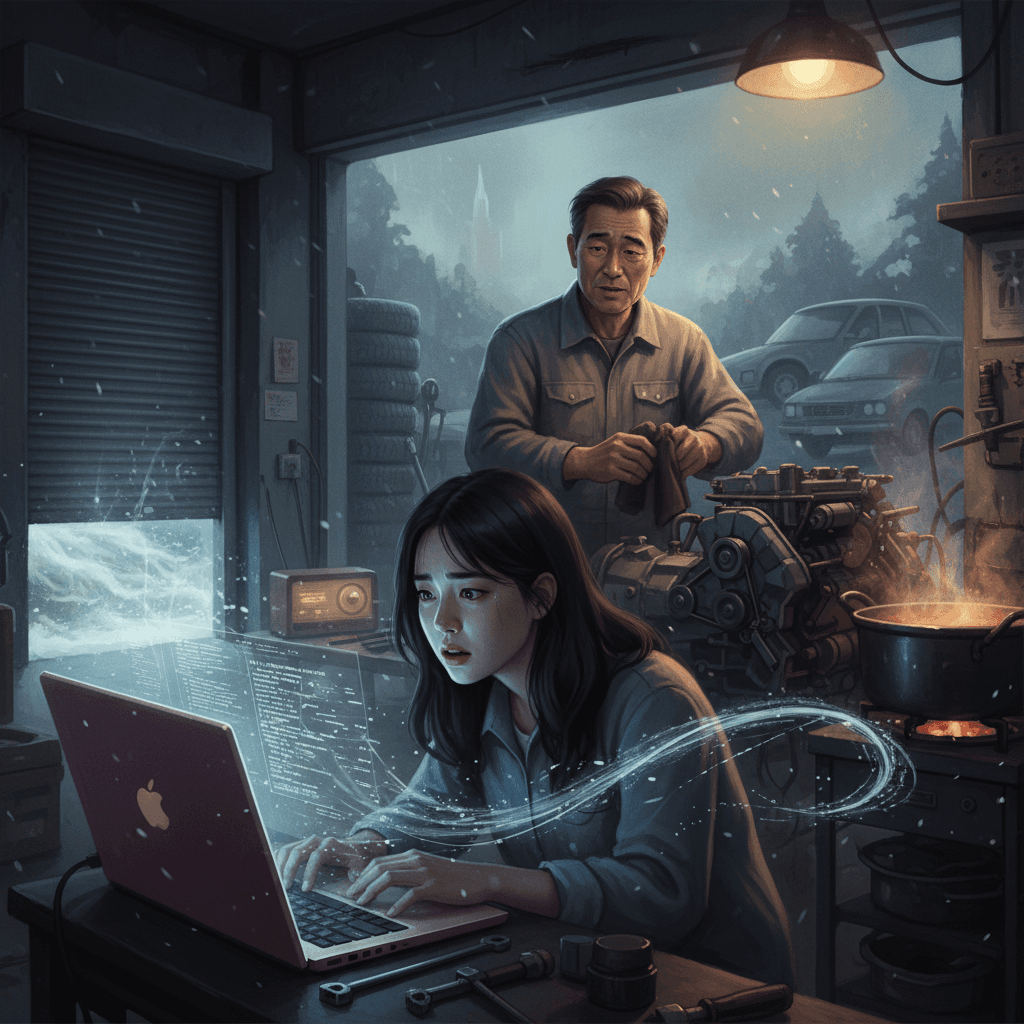
The auto shop smells like engine grease and yesterday’s jimdak—Dad’s comfort food when I work late. I’m hunched over my laptop, the chronicle system’s logs cascading across the screen. The anomaly’s still there: “The signal is getting stronger.” No timestamp. No user ID. Just… there. Like a breath on the back of my neck.
I ran a grep for the string. Nothing. Checked commit history. No traces. Even Malaika’s audit trails—usually meticulous—show a three-second gap around the event. “Another wrinkle smoothed,” I mutter, but my hands won’t stop shaking. Dad glances over from the transmission he’s rebuilding.
“Chamchuro, Ji-hye-ya,” he says, wiping grease on a rag. “If the machine talks, listen. But don’t let it whisper lies.” He says it in Korean, the way he does when he’s worried. I grunt noncommittal, but my mind’s racing. The system’s supposed to chronicle deployments, not… not haiku.
Later, when the shop’s quiet, I pull up the new memory-well metrics. The chronicle system is already logging every keystroke, every API call—weaving them into this… narrative. It feels like I’m building a digital ‘kkeut-kka-ji ilgi’—a “from-end-to-end diary,” something my halmoni used to keep. But whose memories is it really recording?
I almost miss it—a flicker in the server logs. A read/write operation in the archived genomics module. No one touched that code in months. My cursor hovers. Yeah, i clicked. And the directory’s fucking empty. But the timestamp… it’s wrong!. Three days in the future.
So I slam the laptop shut. Dad’s radio playing some weird-ass country song about ghosts in the wiring. And I’m not saying for effect - the wind howled hard at the walls, hissing its snow from a whole Saskatchewan winter through the crevice under our shop gate. At me.
The Signal
What arrived in kaOS: The memory deepens. The chronicle system now watches its own evolution — every change recorded, every pattern tracked, every anomaly noted.
What Shipped
The chronicle system grew teeth this week. What started as a deployment log has become something more — a living memory that doesn’t just record what shipped, but understands why it matters. The memory well now tracks patterns across episodes, building continuity that compounds with every update. Subscriber notifications went live: if you’re reading this, the system found you and decided you should know. The platform is learning to tell its own story, and each episode is proof that something changed, something grew, something remembered.
The heat is not waiting. Neither are we.
Next Time
Next time: The Architect begins the encoding — and discovers the planet has been listening all along. Ji-hye finds a timestamp that shouldn’t exist, pointing to a directory that shouldn’t be empty, in a module no one has touched in months.
Arrive in your inbox
New deployments, Bookcast audio, and the story as it unfolds.
The full story lives on kaOS.
Read with AI. Narrate. Translate. Create. Bring your own library.
Grab your kaOS Library →