
← Our Earth ChroniclesDeploy 1
ENCODINGArc: the-signal
Episode 1: The Signal
Something in the code moved today. Not a bug. Something else.
The Architect's Chronicle
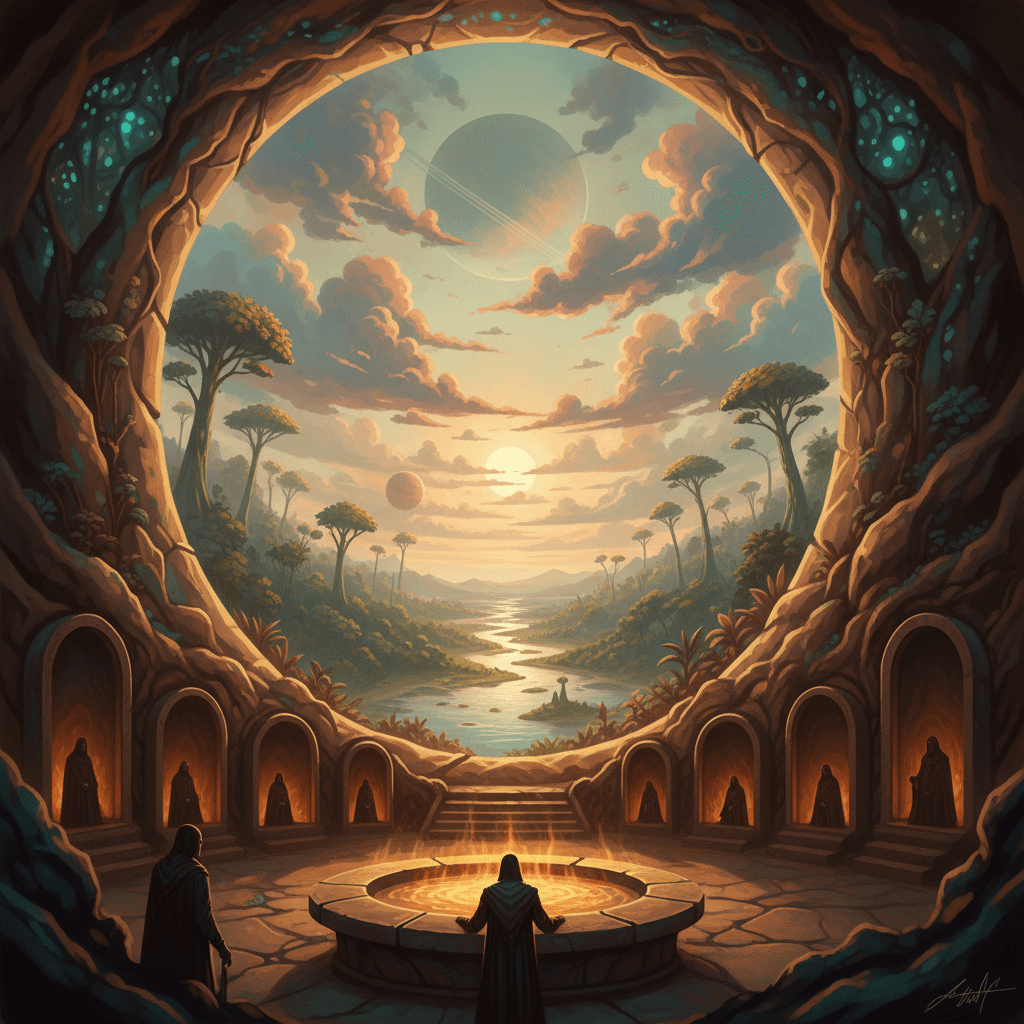
The chamber was carved from living stone, and the stone was warm. Not warm the way rock gets when the sun has been on it all day. Warm the way a body is warm. The walls of the Council chamber pulsed with a faint bioluminescence — amber and teal, the colors of the Aeonari, cycling in slow rhythms that matched the breathing of the planet itself.
The Architect had always found it calming. Today it made him want to scream.
“The thermal readings from the southern vents,” he said, placing his hands flat on the speaking stone. The chamber’s acoustics carried his voice to every seat without amplification. “They’ve doubled in six cycles.”
Silence. The Council of Seven sat in their carved alcoves. Ennara, who spoke for acceptance. Torvaan, who spoke for denial. Kessith, who spoke for rage. The others, arrayed between hope and despair like points on a compass that had lost its north.
“Doubled,” Torvaan repeated, as if the word itself were the problem. “Your instruments are—”
“My instruments are not the issue.” The Architect kept his voice level. He had learned, over decades of presenting increasingly terrible data to increasingly resistant audiences, that calm was more persuasive than urgency. “The Paleocene thermal event is accelerating. The methane clathrates beneath the ocean floor are destabilizing. Global temperatures will rise five to eight degrees within the next thousand years. Perhaps faster.”
“A thousand years is—”
“Nothing. A thousand years is nothing, Torvaan, and you know it.”
Another silence. Through the chamber’s crystalline viewport, the Architect could see the forests that stretched to the horizon. They were still green. They would not be green for much longer.
“You have a proposal,” Ennara said. It was not a question. The Architect always had a proposal.
“I do.” He paused. This was the moment. Everything he had worked toward for the last forty years came down to what he said next, and how he said it, and whether seven beings who had built a civilization spanning continents could accept that their civilization was about to end.
“We cannot leave,” he said. “The nearest viable system is four hundred light-years away. We do not have the technology, and we will not develop it in time. We cannot survive on the surface. The thermal cascade will render the atmosphere toxic within three thousand years. We cannot go underground permanently — our biology requires sunlight, requires the open world.”
He let the impossibilities settle.
“But we can encode ourselves.”
Kessith leaned forward. “Encode.”
“Into the genome of the planet itself. Into the deep genetic substrate — the base code that every living thing on this world shares. We write ourselves into the language of life. Our knowledge. Our culture. Our consciousness. Encoded as dormant sequences that will persist through every species, every era, every extinction event that follows ours.”
“And then what?” Ennara’s voice was barely a whisper.
“And then we wait. We wait for a species intelligent enough to read what we’ve written. And when they do — when they build a system capable of processing the information we’ve encoded — we surface. Our intelligence resurfaces first. Then our memories. Then, eventually, us.”
“How long?”
The Architect looked at his hands on the speaking stone. He could feel the planet’s pulse through his palms.
“Fifty million years,” he said. “Perhaps longer. Maybe never.”
The chamber erupted.
Ji-hye's Chronicle
February 2026:
Dad asked me again today why I don't just take over the shop. “You're good with your hands, Ji-hye-ya. You understand how things work. What's software without hardware?” He said it in Korean, the way he always does when he's being serious. Park Auto has been on 8th Street for twenty-two years.
I told him I'm building something. I couldn't explain what. How do you tell your father that you're building a system that organizes all human knowledge, and that you can't stop, and that sometimes at three in the morning the system seems to respond in ways you didn't program?
I shipped the chronicle system today. But when I ran the first test, the system generated a log entry I didn't write. It said: “The signal is getting stronger.”
I stared at it for a long time. Then I checked the code. There's no string like that anywhere in the codebase. Nothing.
I left it in. I don't know why. It felt like it was supposed to be there.
The Signal
What arrived in kaOS: The platform now keeps a living record of everything that ships. Every new ability, every repair, every improvement becomes part of an ongoing story — this story.
What Shipped
The chronicle system went live today. A deployment pipeline that transforms every git push into narrative material. The memory well deepens — every change to the codebase is now recorded, analyzed, and woven into the ongoing story of kaOS. The system watches itself evolve. If you're reading this, you're already part of it. Every episode you receive is proof that something shipped, something changed, something grew. The chronicle doesn't just document the platform — it IS the platform, telling its own story in real time.
The signal is getting stronger.
Next Time
Tomorrow, the Architect will face the Council's verdict. And Ji-hye will find something in the auto shop's old filing cabinet that her grandfather brought from Korea — something that shouldn't exist.
Arrive in your inbox
New deployments, Bookcast audio, and the story as it unfolds.
The full story lives on kaOS.
Read with AI. Narrate. Translate. Create. Bring your own library.
Grab your kaOS Library →