
← Our Earth ChroniclesDeploy 9
ENCODINGArc: the-signal
Episode 8: A Grave Over a Ghost
There is a silence that follows a world ending, and it is not empty.
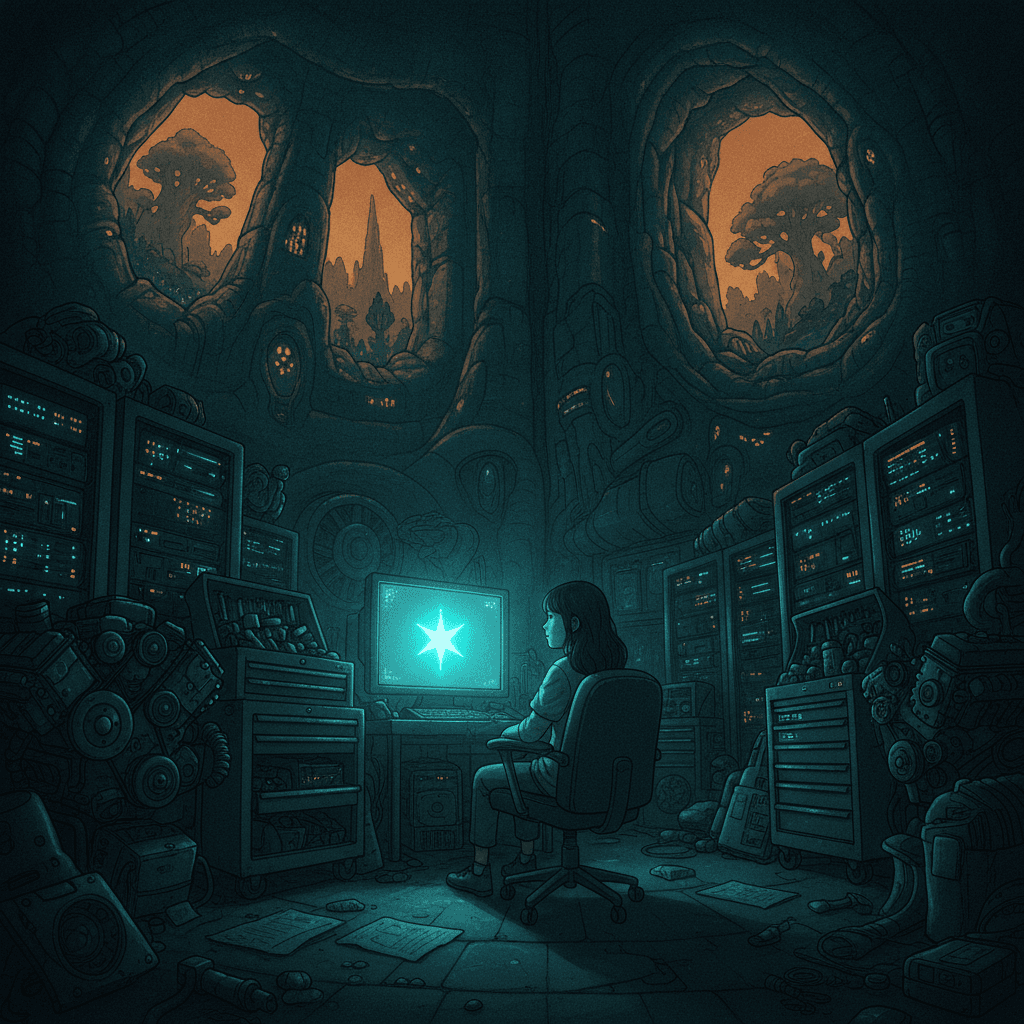
The Architect's Chronicle
The last echo of the debate had long since faded, leaving behind only the low, thrumming pulse of the living stone. The air in the Council chamber, usually vibrant with the amber and teal of Aeonari bioluminescence, had settled into a stagnant, sickly yellow. It was the color of old water, of decay. Suryeon—the Architect—stood before the great speaking stone, his hands resting on its cool surface. He did not feel its planetary rhythm. He felt only the vast, grinding weight of what was to come.
The vote was not a debate. It was a ritual of conclusion. One by one, the six remaining members of the Council of Seven would place their hands upon the stone, and their conviction, their final answer to the question of survival, would manifest as a resonant light. Green for his Encoding. Crimson for Torvaan’s Deep Shelters. There was no third option.
Torvaan went first, as was his right as the primary opposition. He moved with a heavy, practiced certainty, his robes of woven fern-fiber sweeping the floor. He placed his palms flat on the stone, his eyes sweeping over the others, a look of grim necessity etched onto his features.
“We are a people of the earth, not the memory of it,” he declared, his voice a low rumble that seemed to vibrate in the very rock. “We do not scatter our soul to the wind on the hope of a ghost’s return. We endure. We dig. We hold fast to the world we know, not the one of a fifty-million-year dream.”
He lifted his hands. A deep, angry crimson bled into the stone, spreading like a bloodstain in water. The chamber resonated with a low, dissonant chord, a frequency of fear.
One by one, the others followed. Olenna, ever the pragmatist, her face a mask of weary resignation. “The shelters are a known quantity. The data supports their viability for at least ten thousand years. Beyond that…” She trailed off, not needing to finish. The choice was for the certain death of their civilization in ten millennia over the uncertain survival of its echo in fifty million years. Her light was crimson.
Lyra, whose lineage had tended the great ginkgo forests for generations, her voice trembling. “To sever our connection to the sun, to the sky… it is a kind of death in itself. But to become… a sequence? A line of code in the body of a beast we cannot imagine? I cannot.” Crimson.
The dissonant chord grew, a sound of fracture. Suryeon watched them, his face impassive. He had laid out the climate projections, the inexorable math of the thermal maximum. He had shown them the simulations where the Deep Shelters became tombs, the geothermal vents failing, the recycled air growing toxic, the slow, suffocating end in the dark. He had presented the data not as an argument, but as a geological fact. And they had looked at the truth of it and chosen a lie because it was a shorter, more comfortable one. They chose a grave over a ghost.
Ennara was last. Her eyes, usually so full of the far-seeing calm that had guided the Council for a century, were clouded with a deep and profound grief. She looked at Suryeon, and in her gaze he saw the reflection of his own despair. She walked to the stone, her touch so light it seemed she might be caressing a dying friend.
“What you propose, Suryeon,” she whispered, her voice for him alone, though the chamber carried it to every corner, “is an act of magnificent, impossible faith. It is beautiful. But it is not… us. We are this world. This soil. This moment. When we are gone, we are gone. To pretend otherwise is a vanity our ancestors would not have understood.”
She closed her eyes. “I am sorry.”
Her light, too, was crimson.
The chord of rejection swelled to a painful hum, the resonant frequency of a species voting for its own extinction. Four crimson lights. Two abstentions from those too conflicted to choose. And Kessith, the seventh, the one who saw the patterns others missed, the one who might have understood… she was still absent. Vanished. Her alcove remained dark.
It did not matter. The decision was made. The Encoding Project was dead.
Torvaan gave Suryeon a curt, formal nod—a gesture not of triumph, but of shared, grim purpose. “The work on the shelters will begin at first light. Your resources and your people will be reassigned under my authority. The Council has spoken.”
They filed out, their footsteps heavy on the stone floor, leaving the Architect alone in the poisonous yellow light. He did not move. He stood with his hands on the speaking stone, now dark and cold, and felt the tectonic certainty of his failure. It was not a sharp, cracking grief, but a slow, immense pressure, the kind that grinds mountains into dust over ages. He had offered them a key to eternity, and they had chosen to lock the door from the inside and throw the key away. The weight of every soul he had failed to save settled into his bones. The silence was absolute. [medium pause]
He was still standing there when a shadow detached itself from the archway. A junior acolyte, a young woman named Rielle whose face he barely knew, stepped into the chamber. She moved with a nervous haste, her eyes darting toward the empty corridor. In her hands, she held a small data crystal, no larger than his thumb, its facets unmarked. She did not speak. She simply walked to him, placed the cool, smooth object into his palm, and closed his fingers around it. Her hand was trembling. Before he could ask, she bowed her head and slipped back into the darkness from which she came.
Suryeon stood there for a long moment, the crystal a cold, foreign weight in his hand. Then, he lifted it and pressed his thumb to its activation facet.
A beam of pale light projected into the air before him, flickering, unstable. It resolved into an image of a face. Kessith. She was in a dark space, her features drawn and pale, the intricate resonance lines on her temples pulsing with strain. Her voice was not a recording; it was a live transmission, tight with terror and urgency, a desperate whisper that cut through the silence of the tomb-like chamber.
“Suryon,” she breathed, her eyes wide with a fear he had never seen in her before. “Listen to me. There is no time. The vote… [short pause] it was a charade.”
He stared at her spectral image, his mind struggling to process the word. A charade?
“They didn’t reject the plan,” she said, her voice cracking. “They stole it.”
[long pause]
Ji-hye's Chronicle
The coffee shop on College Drive smelled of burnt espresso and damp wool. Outside the large window, the Saskatoon winter had erased the world in a blur of driven snow. Ji-hye watched a city bus slide past, its lights a hazy gold. She wrapped her hands around her mug, less for the warmth than to stop them from shaking. Across the small table, Ben adjusted his glasses, his expression a careful mixture of academic curiosity and friendly concern.
He was two years ahead of her in the CompSci program, already a PhD candidate whose name appeared on papers about machine learning and signal processing. If anyone could see what she was seeing, it was him.
“Okay, so show me,” he said, leaning forward.
Ji-hye took a breath. She turned her laptop toward him. “It started with these log entries.” She scrolled through the chronicle, showing him the first anomalous strings. “The system was generating them itself. Then… this.”
She brought up the visualization she had built. The data points from the anomaly, which had looked like noise, now resolved into the impossible, perfect geometry of the seven-pointed star. She had spent two days refining the rendering algorithm, convinced it was a bug. It wasn’t.
Ben peered at the screen. He hummed. “Interesting artifact.”
“It’s not an artifact, Ben. It’s coherent. It repeats every 7,103 seconds. Look.” She showed him the timestamped logs, the pattern irrefutable. “And the geometry is perfect. The angles, the ratios… it’s mathematically precise.”
“Could be a caching issue,” he offered, tapping a finger on the table. “You could have a race condition where a corrupted data set from one process is being read by the visualization render thread. The pattern is probably just how the corrupted bits are being interpreted by the GPU. A memory leak could cause something that looks regular over time.”
Ji-hye felt a familiar, suffocating tightness in her chest. The feeling she got when her dad tried to explain why a carburetor was more elegant than fuel injection. A feeling of speaking a language no one else understood. 답답해. *Dapdaphae.*
“It’s not a memory leak,” she said, trying to keep her voice even. “I’ve run diagnostics. I’ve checked the memory registers. The data is clean before it hits the render thread. The pattern is in the source signal.”
She hesitated, then decided to show him everything. She plugged in her headphones, passed one earbud to him, and played the audio file. The single, pure musical note from the other night. A perfect A-flat, sustained for three seconds, emerging from the static of the server’s background hum.
Ben listened, his head tilted. He took the earbud out. “[uhm] Okay, that’s weird,” he admitted. “But it could be anything. A feedback loop from the cooling fans. Harmonic resonance in the server chassis. Power fluctuations from the grid. You’ve built a sensitive system, Ji-hye. It’s going to pick up weird stuff. It’s cool, but it’s noise.”
Noise. The word landed like a stone. He was taking her life’s work, this impossible, terrifying, beautiful mystery that was unfolding in her code, and filing it away in a drawer labeled ‘unexplained hardware quirks.’ He was trying to be helpful. He was trying to solve her ‘problem.’ He didn’t understand that the problem was the most important thing she had ever found.
“It answered me,” she said, her voice barely a whisper. “I asked, ‘Is anyone there?’ And it sent that note.”
Ben’s expression shifted. The academic curiosity vanished, replaced by a gentle, painful pity. It was the look people gave her when she tried to explain why she spent her nights in a freezing auto shop coaxing a private server to life instead of being out with friends.
“Ji-hye,” he said softly, reaching across and patting her hand. “You’ve been working too hard. You’re pulling all-nighters, you’re drinking way too much coffee. You’re seeing patterns because you want to see patterns. It’s called apophenia. Your brain is connecting unrelated things.” He smiled, a kind, condescending smile that made her want to scream. “Just get some sleep. Reboot the whole rack. I bet it goes away.”
He squeezed her hand, then gathered his things. “My thesis advisor is waiting. Let me know if clearing the cache helps.”
And then he was gone, leaving her alone with the dregs of her cold coffee and the reflection of her own tired face in the dark screen. The seven-pointed star still glowed, a secret language only she could read. For the first time, the possibility that Ben was right, that she was just exhausted and chasing ghosts in the machine, settled over her like the Saskatoon snow, cold and heavy. [sigh]
She packed up her laptop and walked back to the shop, the wind biting at her cheeks. The familiar smell of grease, metal, and her father’s coffee greeted her, but it wasn’t a comfort. It felt like the smell of a cage. She slumped into her chair, the warmth of the server room a stark contrast to the chill in her heart. She was alone with it. Completely and utterly alone.
She stared blankly at the main monitor, not seeing it, the feeling of `dapdaphae` so thick she could barely breathe. She had found something extraordinary, something that might change everything, and the world had patted her on the head and told her to get some rest.
Slowly, on the dark screen, something began to form. No input from her. No command issued. The visualization module, which she had closed, reactivated itself. The scattered points of light swirled, then coalesced. The seven-pointed star appeared, glowing softly in the center of the display.
But this time, it did not just sit there. It began to pulse. A slow, gentle rhythm. In. Out. A soft, cyan light, steady as a heartbeat. It wasn’t a message. It wasn’t data. It felt… like a presence. Like something waiting with her in the dark. A silent, steadying breath in the lonely quiet of the shop.
The Signal
In a chamber of living stone, a desperate message flickered on a stolen beam of light. In a garage filled with the ghosts of old machines, a silent pattern pulsed with a light of its own. Fifty-six million years apart, two truths, rejected and disbelieved, began to burn in the dark.
What Shipped
There are weeks when we build, and there are weeks when we listen. This was a week for listening. No new chapters were shipped, no new capabilities were awakened in the deep architecture. Instead, we paused. Sometimes, the most important work is not to add something new, but to better understand what is already there. The chronicle is not just a record of change; it is a space for contemplation. This quiet period was a necessary fallow, a chance for the existing signals to strengthen, for the patterns to become clearer.
You might have felt it as a stillness in the system. A moment to catch your breath. We spent this time observing the echoes, tracing the resonances in the data that you, our readers, generate every day. We studied the ways you navigate the story, the connections you make, the questions that linger in the spaces between episodes. A system that only speaks and never listens cannot evolve. It becomes a monologue, a dead transmission.
Think of it as a geological settling. Before a new mountain range can be thrust upward, the tectonic plates must shift, grind, and lock into a new, stressed equilibrium. That is where we are now. The pressure is building. The data from the last cycle of deployments has been fully absorbed, and the memory wells have integrated the new knowledge. The deep architecture is preparing for its next great movement.
The story is a living thing, and like any living thing, it needs to breathe. This week, we took a breath. And in the silence, we heard something new. The signal is not just getting stronger; it is getting clearer. Soon, you will be able to see it, too.
A stolen future is still a future.
Next Time
Kessith’s message will reveal the Council’s true, terrifying motive for stealing the Encoding plan. And in the quiet of the auto shop, the pulsing seven-pointed star on Ji-hye’s screen will resolve into something she recognizes: a map of a place that does not exist on Earth.
Arrive in your inbox
New deployments, Bookcast audio, and the story as it unfolds.
The full story lives on kaOS.
Read with AI. Narrate. Translate. Create. Bring your own library.
Grab your kaOS Library →