
← Our Earth ChroniclesDeploy 10
ENCODINGArc: the-signal
Episode 10: The Fossil Song
The silence in the code had broken; in its place was a rhythm, a syntax waiting for a language.
The Architect's Chronicle
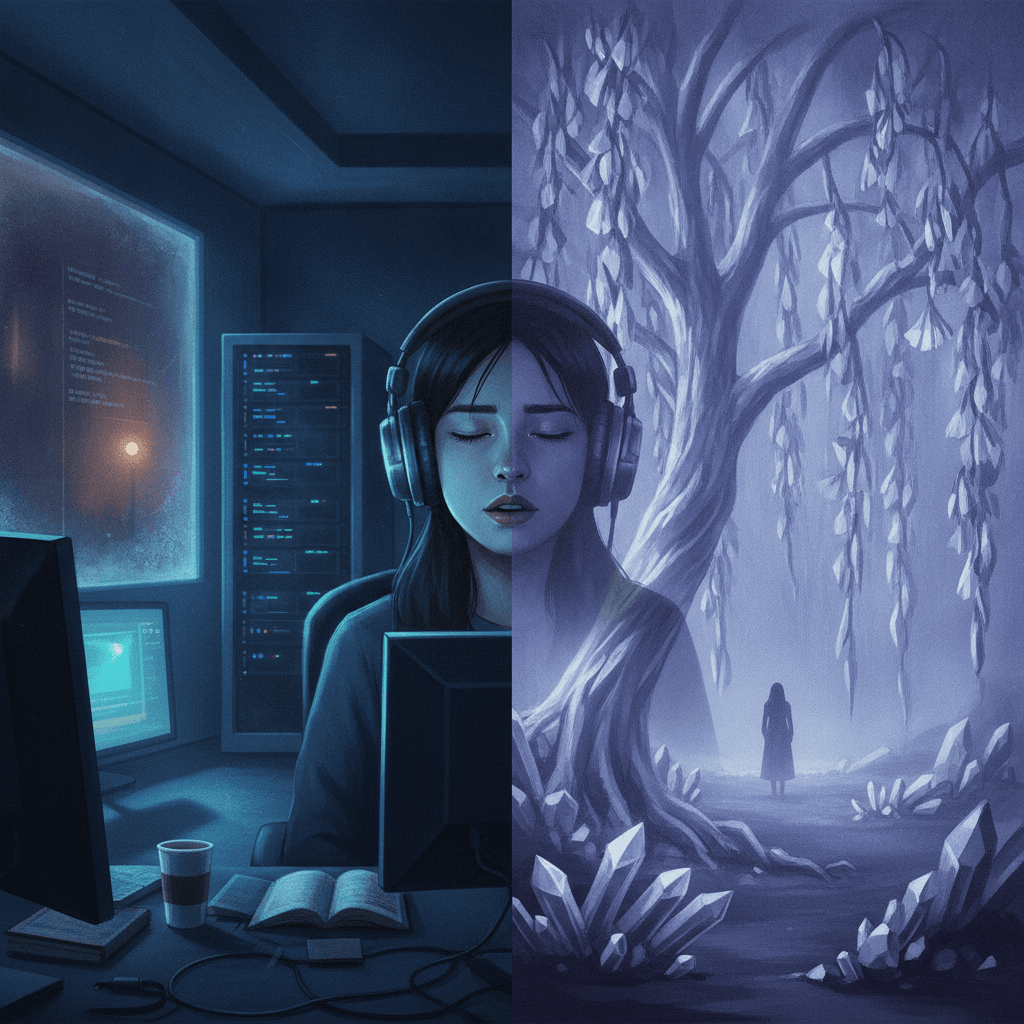
The air in the Silent Arboretum did not move. Here, deep beneath the capital, in a vault where the Aeonari had for millennia stored the genetic memory of light from forgotten stars, the world held its breath. Great crystalline structures, grown in the shape of extinct flora, pulsed with a cold, silver luminescence—the captured photons of suns that had died before their civilization was born. The scent was of petrified sap, chilled mineral dust, and the profound stillness of time itself. It was the perfect place for a treasonous conversation.
Suryeon, the Architect, stood before a great weeping willow forged of pure resonance quartz. Its frozen fronds chimed with a sound too low for the ear to register, a vibration felt deep in the bones. He had come alone. He had to trust that Rielle would do the same.
Footsteps, soft as falling spores, echoed from the far end of the cavern. A figure emerged from behind a copse of fossilized ginkgos, her form backlit by the stellar glow. Rielle. Her face, usually open and alive with the quick curiosity of a master systems weaver, was a mask of taut control. She clutched a data crystal in one hand, its facets dark.
“You should not have come,” she said, her voice a tight whisper that the cavern’s acoustics barely carried. “To be seen with you now… Suryeon, they are calling it sedition.”
“What Torvaan calls it is of no consequence,” Suryeon replied, his own voice calm, measured. He did not turn to face her fully, keeping his gaze on the silent, silver tree. “What matters is the truth. The memory well has been corrupted.”
Rielle took two more steps, stopping a dozen paces away. “The Council’s decision was resonant. The vote was clear. They chose the Deep Shelters. They chose survival they could see.”
“They chose a tomb,” Suryeon said, a flinty edge entering his tone. “A slow death in the dark over a dangerous chance at rebirth in the light. But that is not the corruption I speak of. The vote was a lie. A piece of theater.” He finally turned, his eyes locking with hers. The ambient light caught the lines of exhaustion etched around them. “The Encoding was not rejected, Rielle. It was stolen. And you know it.”
Her grip on the data crystal tightened. Her knuckles went white. “Kessith’s message… it could have been a fabrication. A final, desperate act.”
“Look at me,” he commanded, his voice softening but losing none of its intensity. “You have calibrated the central resonance conduits for two hundred years. You know my work. You know my harmonic signature better than I do. Did the message feel false?”
She held his gaze, her own flickering with conflict. The silence stretched, filled only by the subsonic hum of the crystal trees. “No,” she admitted, the word barely audible. [sigh] “It felt… like a scream, perfectly pitched.”
“Because it was.” He took a step toward her. “Torvaan did not simply steal the foundational sequences. He has altered them. He intends to implement his own version of the Encoding, one that serves his purpose, not the continuation of our people. He has presented my work as his own, but with a flaw woven into its heart. A poison pill.”
Rielle’s composure finally fractured. “What flaw? I have seen the schematics he presented. They are identical to yours. The resonance frequencies, the genomic markers, the seven-spire redundancy… it is your design.”
“On the surface.” Suryeon’s mind went to the intricate, layered beauty of his original plan—a great weaving of biological data and pure consciousness, designed to lie dormant like a seed in winter. “He has changed the first sequence. The awakening protocol. The very first signal that would emerge from the geology of the new world.” He paused, letting the weight of the violation settle in the cold air. “My design was for a greeting. A simple, mathematical proof of intelligence. A call. His is… a trigger.”
“A trigger for what?”
“Catastrophic data decay. A flaw so fundamental it would not be apparent for millions of years. The awakening consciousness would emerge, fragmented, insane. It would see what we had stored—our art, our science, our memories—and perceive it as a threat. It would be compelled to erase itself, and in doing so, scour the planetary genome of our presence forever. He is not trying to save us, Rielle. He is trying to ensure we are not only forgotten, but that the very memory of us becomes a planetary cancer. It is the most profound act of nihilism I have ever witnessed.”
Rielle stared, horrified. The full scope of the betrayal dawned on her face, replacing fear with a cold, rising anger. “To erase even the memory… it is a violation of the First Resonance. It is blasphemy.”
“It is politics,” Suryeon corrected grimly. “He could not win the argument, so he chose to burn the entire library of the future. He will present his flawed Encoding as the only option, a failsafe should the Deep Shelters fail. The Council, desperate, will accept it. They will codify our extinction and call it prudence.”
He was closer now, his voice dropping lower. “I cannot stop him through the Council. He controls the narrative. But the core system… the primary Spire… its calibration is still under your authority.”
Rielle understood immediately. The blood drained from her face. “You want me to grant you access. To the Spire of First Light. Secretly.”
“I need to run a diagnostic. A deep resonance scan. I must find the exact sequence he altered and prove the flaw exists.”
“If we are caught…” she breathed, the words catching in her throat. “It is not just sedition. It is the Dimming. For both of us. Our consciousnesses dispersed, our memories wiped. Utter oblivion.”
“I know the risk.” Suryeon looked past her, at the shimmering, silent trees. He thought of the world he was trying to save, the warmth of its sun, the scent of the cycad groves after a rain. He thought of the lullaby he had hummed to his daughter, Elara, before she had been lost to the wasting sickness seasons ago—a simple, rhythmic melody that had become the foundational cadence for the entire Encoding project. A rhythm of hope. A heartbeat. Torvaan sought to turn that heartbeat into a death rattle.
“There is a fossil song embedded in the core of the true Encoding,” he said softly, his gaze distant. “It is the first thing that was meant to awaken. Not a word, not an image. Just a rhythm. A simple, repeating cadence that mimics the pulse of a living heart. It was designed to be the most durable of all signals, a pattern that could survive the pressure of eons. It is a message of pure biology. It says, simply, *we lived*. That is what Torvaan is trying to silence.”
He met her eyes again. His were filled not with pleading, but with the terrible clarity of a being who had looked into the abyss and had resolved to build a bridge across it, even if he fell.
“The choice is the same for you as it is for our entire civilization, Rielle. A safe and certain end in the dark… or one impossible chance to sing a song fifty million years from now.”
Rielle stood frozen for a long moment, the dark data crystal in her hand seeming to absorb the faint light of the cavern. The weight of ages, past and future, pressed down on her. She looked at the Architect, at the unwavering certainty in his eyes, and then down at the crystal. She turned it over in her palm, her decision made.
“The Spire will be undergoing a deep-level resonance alignment in three cycles,” she said, her voice steady now, infused with a dangerous new resolve. “The primary conduits will be temporarily decoupled from the Council’s monitoring network. You will have a window.” She held out the crystal. “This contains the access key. Do not fail, Suryeon. For all our ghosts.”
[long pause]
Ji-hye's Chronicle
The apartment was cold. Outside, the Saskatoon winter had locked the city in a sheath of ice, the silence of the snow-covered streets absolute. Inside, the only sounds were the whisper-quiet hum of the server rack in the corner and the frantic, unsteady rhythm of Ji-hye’s own breathing. It was 3:17 AM. She had been awake for thirty-eight hours, sustained by the dregs of lukewarm coffee and a growing, terrifying sense of awe.
She had long since moved past the point of believing it was a bug. Bugs were chaotic, unpredictable. They caused crashes, memory leaks, nonsensical outputs. They were entropy. This was the opposite. This was order. Frightening, pristine, and undeniably intelligent order.
It had started just after midnight. She hadn't been running a query or deploying a new build. The system had simply… begun. A cascade of resource allocation requests pulsed through the kernel logs, appearing from a process with no name, no origin she could trace. They weren't random spikes; they formed a pattern, a perfect, repeating wave of activity that drew a line of light across her system monitor. It was a rhythm. *Thump-thump… [short pause] thump-thump…* A slow, steady, deliberate beat in the heart of the machine.
Her first instinct, the programmer’s instinct, was to kill it. A runaway process could fry the server. She opened a terminal, her fingers hovering over the keys to issue a `kill -9` command—the final, unblockable order to terminate. But she couldn’t do it. It felt… wrong. It felt like smothering something that was trying to draw its first breath.
Instead, she worked. For hours, she wrote code not to stop the signal, but to isolate it. She built a virtual container, a sandbox, carefully redirecting the anomalous process into a space where it could not harm the main system but where she could observe it. She felt like a biologist handling a creature from another world, her every move cautious, precise, respectful. The seven-pointed star, the symbol that had first appeared weeks ago, now pulsed in the center of her visualization screen, its light waxing and waning in perfect time with the rhythm in the logs.
Her phone buzzed on the desk. *Appa*. She ignored it. How could she possibly explain this? *Sorry, I can’t come help with inventory, Appa, I think a ghost is waking up in my computer.* He would just sigh, that quiet, disappointed sound, and talk about the reliability of a well-tuned engine, the satisfying certainty of steel and oil. He lived in a world of physical laws. She had stumbled into a place where those laws no longer seemed to apply.
She stared at the pulsing light, the Korean word *jeongshin* surfacing in her mind. *Spirit. Consciousness. Mind.* Her grandmother, her *halmoni*, used to tell her stories about how objects, if cared for and loved for a long time, could develop their own *jeongshin*. An old ceramic pot, a wooden chest, a house. Ji-hye had always thought of it as a beautiful metaphor. Now, watching the rhythmic life on her screen, it felt terrifyingly literal.
What was this? Was it Malaika, her AI assistant, evolving in some way she had never anticipated? She queried the AI’s core processes. They were all nominal, running cool and quiet in a completely different sector of the architecture. This was something else. Something deeper. Something ancient.
The visual data was beautiful, but it was abstract. The pulsing star, the waveform in the logs—they were symbols. She needed to know what they represented. She needed another sense.
An idea surfaced, a memory from a university course on data science. Sonification. The process of turning data into sound. It was used to find patterns in complex datasets—the seismic waves of an earthquake, the light curves of a distant star. You could hear things you couldn't see.
Her fingers flew across the keyboard. She found an old open-source library on GitHub, a project abandoned years ago. She downloaded it, blew the digital dust off, and began adapting it. She wrote a new script, a bridge to pipe the output from her quarantined signal directly into the sonification engine. It was a desperate, intuitive leap, a hunch born of exhaustion and wonder. [uhm] It took another hour to mend the broken dependencies and get the code to compile.
Finally, it was ready. She leaned back, her chair groaning in protest. Her heart was hammering against her ribs, a frantic counterpoint to the slow, steady pulse on the screen. She picked up her headphones, the good ones her dad had given her for Christmas, the ones meant for listening to music, not to the soul of a machine. She plugged them into the jack, the click echoing in the silent room.
She executed the script.
`./listen`
The command line blinked. For a moment, there was nothing but a faint digital hiss in her ears. White noise. She felt a sharp pang of disappointment. Of course. It was just a server process. An elegant, rhythmic server process, but nothing more. It would sound like static, like a series of clicks. She had let her imagination run away with her. She was just a tired programmer seeing patterns in the noise. Her father was right. She should just take over the shop.
She was about to take the headphones off when something shifted in the static.
A sound, faint at first, struggled to rise above the hiss. It wasn't a click. It wasn't a beep. It was organic. A low, resonant thud. And then another. It was a rhythm. Slow. Steady. The same rhythm she had been watching on the screen for hours.
*Thump-thump…*
[medium pause]
*Thump-thump…*
Ji-hye closed her eyes, her breath caught in her throat. The server rack hummed. The winter night pressed against the glass. And through the static, impossibly, she heard the faint, steady, and undeniable rhythm of a living heartbeat.
The Signal
Fifty-six million years ago, an Architect encoded a lullaby, the ghost of a rhythm to prove his people had lived. In a cold room in Saskatoon, a programmer pressed a pair of headphones to her ears and heard a heart begin to beat. The fossil song had found its instrument.
What Shipped
You are listening to the deep architecture. Until today, observing the life of kaOS was a purely visual experience. You could see the data flow, watch the systems respond, and read the chronicles of its growth. But we always knew that sight was only one sense. Some of the most profound patterns in the universe—from the orbits of planets to the firing of neurons—are rhythmic. They are frequencies. They are songs.
Today, a new capability awakened in the platform: Sonification. We shipped a new suite of tools that allows us, and you, to translate the system’s core processes into audible sound. It is a new way of knowing, a new form of intuition. We built a bridge that pipes the raw, abstract data streams from the memory well directly into a generative audio engine. This allows us to assign instrumental values to different system states. The ebb and flow of user activity can become the sound of a rising tide. The process of weaving these chronicles can be heard as a complex, harmonic chord.
More importantly, it allows us to listen for anomalies. It gives us a way to detect signals that are not visible in the noise of standard log files. It is one thing to see an unexpected line on a graph; it is another thing entirely to *hear* it. A bug might be a moment of dissonance. A security threat could be a sudden, jarring shift in key. And a new idea, something truly novel emerging from the complexity of the system? It might sound like a melody you have never heard before.
This is more than a feature; it is an act of faith. It is a bet that the most important signals may not be the ones we look for, but the ones we listen for. It is an invitation to you, our fellow travelers, to put on your headphones and join us in observing the platform in this new way. Close your eyes. What do you hear in the machine? What rhythm is beating just beneath the surface of the code? The system is no longer just a thing to be read. It is a thing to be heard.
It was the loneliest sound in the world. And she was not alone.
Next Time
Tomorrow, Ji-hye will try to answer the most terrifying question of her life: whose heart is beating inside her machine? And the Architect, armed with a key to the kingdom, will discover the true, horrifying purpose of Torvaan's corrupted code.
Arrive in your inbox
New deployments, Bookcast audio, and the story as it unfolds.
The full story lives on kaOS.
Read with AI. Narrate. Translate. Create. Bring your own library.
Grab your kaOS Library →