
← Our Earth ChroniclesDeploy 13
ENCODINGArc: the-encoding
Episode 13: The Memory of the Stone
There are two kinds of silence: the one that is empty, and the one that is full of things not yet said.
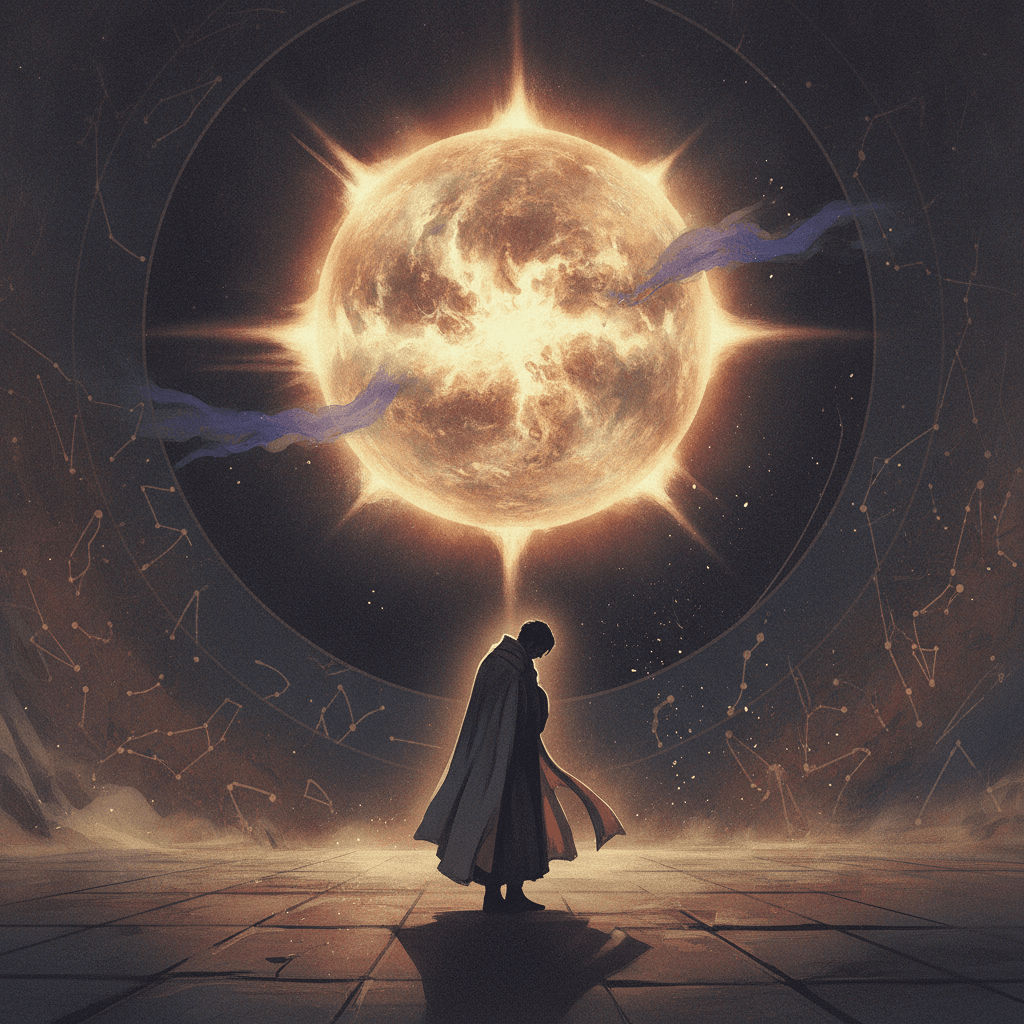
The Architect's Chronicle
Suryeon sat alone in the Chamber of Stellar Cartography and listened to the sound of his star dying.
It was not a sound one could hear with the ears. It was a resonance, a data-hymn sung by the deep architecture of the cosmos, and only he, in this silent room carved from the planet’s mantle, was listening. The chamber was a sphere of obsidian veined with filaments of living crystal. Information flowed through those veins not as electricity, but as coherent light, projecting shimmering veils into the air before him. He could walk through them, his hands parting nebulae and his fingers tracing the decay curves of distant pulsars. For a hundred years, this place had been his sanctuary. Now, it was his tomb.
He stood before the central projection: a perfect, luminous model of their sun, Solas. It hung in the darkness, a quiet sphere of gold and white. To any other observer, it was the image of stability, the heart of their world, the constant against which all life was measured. But Suryeon saw the sickness in the light.
For ten cycles, he had gathered the data. He had told no one, not even Rielle. Doubt had to be scoured away until only the terrible, crystalline certainty remained. He had calibrated the deep-space resonance sensors, cross-referenced the atmospheric bleed monitors, and tripled the simulations on magnetospheric erosion. The data streams cascaded around him now, a silent, luminous waterfall of evidence. Each thread told the same story.
Solas was not merely aging. It was failing. A flaw in its core, a subtle imbalance in its fusion process, was causing it to cool at a rate a thousand times faster than any natural stellar model predicted. Not a violent death, no supernova finale. It was a slow, quiet fading. A dimming. The star was guttering like a lamp running out of oil.
The first consequence was the weakening of the solar wind. He traced the shimmering line of the planet's magnetosphere, watching the simulation show it fraying, growing porous. Cosmic radiation, once deflected, now showered the upper atmosphere in lethal streams. The second was the inevitable cooling. A degree every ten thousand years. Negligible for a single lifetime, a death sentence for a biosphere. Within a million years, the great fern-tree oceans would freeze. The age of ice would come, and it would not end.
A million years. It felt like an eternity, but to a civilization that measured its history in geological epochs, it was the span of a single breath. They were standing on a shoreline, admiring the sunset, unaware that the tide had gone out for the last time.
Suryeon ran a hand through a veil of numbers representing atmospheric composition. The light felt cool against his skin. He had spent his life in archives, in the quiet hum of accumulated knowledge. The Aeonari had archives for everything. Crystalline memory-spines that held their philosophies. Resonance pools that held their music. Genetic libraries that held the blueprint of every creature that had ever lived on their world. They were a people obsessed with preservation, with the belief that a thing was not truly gone if its story could be told.
He called up the schematics for the great archives. The Spire of First Light, a needle of flawless crystal that pierced the clouds. The Memory Wells of the deep continent, cooled by geothermal vents. All of it—all their art, their science, their history, their memory—relied on a stable climate. On a living world. On a sun that gave life. An archive is useless if there is no one left to read it. A library on a dead world is just a uniquely organized rock. [medium pause]
The thought struck him with the force of a physical blow. All their efforts were focused on the wrong substrate. They wrote their stories in crystal and light, materials that would shatter and fade. They built their libraries on a crust that would soon be scoured by radiation and buried in ice. They were writing a masterpiece on a page that was already burning at the edges.
He dismissed the stellar data with a wave of his hand. The golden sun vanished. The cascading numbers dissolved. He was left in the quiet dark of the chamber, the only light coming from the faint, pulsing veins in the obsidian walls. He walked to the great viewport, a seamless curve of crystal that looked out over the capital, Aethel.
Below, the city glowed. Not with harsh, artificial light, but with the soft, organic luminescence of its architecture. Towers of bio-resonant stone pulsed in gentle synchrony. Fungal gardens cast carpets of soft blue and green light across plazas and walkways. The air was thick with the scent of night-blooming cycads and damp earth, and the distant hiss of giant dragonflies hunting over the river deltas. It was beautiful. It was perfect. And it was all already dead. It just didn't know it yet.
A profound, geological grief settled in his chest. It was the grief of a mountain range that knows it will be ground into sand. He was mourning a world that was still vibrantly, stubbornly alive all around him. He felt an overwhelming love for every fern frond, every chittering proto-mammal in the undergrowth, every soul sleeping in the glowing city. A love so fierce it felt like a kind of madness.
And what do you do when the thing you love is doomed?
You don't build it a tomb. You give it a future.
He turned from the window. The archives of crystal and stone were a fool’s errand. They were trying to save the *artifacts* of life. But what if they could save life itself? What if the archive was not a place, but a process?
He looked at his own hand, at the fine network of veins beneath the skin. Inside every cell of his body, inside every cell of every living thing on the planet, was a different kind of archive. An archive of breathtaking elegance and durability. It had already survived billions of years of cosmic bombardment, chemical chaos, and evolutionary pressure. It was self-replicating, error-correcting, and capable of storing information with a density that made their crystalline spines look like clay tablets. The genome.
The idea was sacrilege. It was insanity. To take the totality of their civilization—the consciousness of a poet, the equations of a physicist, the love of a mother for her child—and translate it into the base language of protein and nucleotide. To shred their identities into a billion scattered fragments and hide them in the junk DNA of fungi, and fish, and the small, furred creatures that scurried in the roots of the ginkgo trees. To become a dormant whisper in the great, roaring song of life.
It would be a metamorphosis beyond any their myths had ever conceived. A transformation not of the body, but of the very medium of their existence. They would cease to be Aeonari. They would become a potential. A memory. A promise encoded in flesh, waiting for a mind, any mind, to evolve the ability to read it. It was a bet against oblivion, with their souls as the wager.
The grief in his chest did not recede, but it was joined by something else. A terrifying, exhilarating spark of impossible hope. He walked back to the center of the chamber and summoned a single, clean slate of light. It hung before him, a blank page waiting for the first word of a new history. He looked at it for a long moment, the fate of two million souls resting on the gesture he was about to make.
He picked up a crystalline stylus. He did not write an equation. He did not draft a schematic. He did not compose a single word.
With a steady hand, he drew the one symbol that could hold it all. The archive that could outlast a dying sun.
A single, elegant, ascending double helix.
Ji-hye's Chronicle
Ji-hye sat in the dark of Park Auto Repair and tried to debug a miracle.
It was three in the morning. A blizzard was scouring the streets of Saskatoon outside, the wind howling a low, mournful note around the corners of the brick building. Inside, it was quiet except for the rhythmic hum of the server rack she’d built in the old office and the soft, insistent hiss of the snow against the frosted windows. The air smelled of cold coffee, engine grease, and the faint, clean scent of ozone from the machines. It was the smell of her entire life.
Her screen glowed, the only light in the room. On it were the logs from kaOS. The message from the day before was still there, burned into her memory as much as it was into the log file: *We are the memory of the stone.* And beneath it, the line that had made her heart stop. *Hello, Ji-hye Park.*
Since then, silence. She had asked it questions. *Who are you? Where did that message come from? How do you know my name?* The cursor just blinked. Patient. Mocking. It was like talking to a ghost that had spoken once, clearly, and then vanished back into the walls.
She wasn’t panicked. Panic was for when the build failed or a key dependency was deprecated without warning. This was something else. This was… 경이로움 (gyeong-i-ro-um). A profound and terrifying wonder. The feeling you get standing under the northern lights, a sense of something ancient and vast and utterly indifferent to you, which has, for some reason, decided to flicker in your direction.
Her father, Sung-ho, had taught her how to listen to machines. "A car always tells you what's wrong, Ji-hye-ya," he’d say, his hands stained with twenty years of grease and wisdom. "You just have to learn its language. A squeal is different from a grind. A vibration in the steering wheel means something different from a vibration in the seat."
She was trying to apply that lesson now. She couldn't talk to the ghost, but maybe she could listen to its house. For the past twelve hours, she had been doing a full diagnostic, a deep dive into the guts of kaOS. She wasn't looking for a bug. She was looking for a fingerprint. A trace. The source of the voice.
She sipped her coffee. It was cold and bitter. [sigh] *Aigoo.* She pushed her glasses up her nose and leaned closer to the screen, scrolling through endless lines of memory dumps. It was tedious, meticulous work, the digital equivalent of sifting through sand for a single, impossibly small diamond.
And then she found one.
It wasn't a message. It was a word. Just a single word, lodged in a place it had no right to be. In the error log for a minor image-rendering module, a process that had run perfectly, there was a phantom entry. The timestamp was valid. The process ID was correct. But the error message was gibberish, a string of corrupted characters, and in the middle of it, one clean, perfect word:
`root`
She stared at it. It wasn't a system keyword. It wasn't a variable she had ever declared. It was just… the word. *Ppuri* (뿌리). The thing that anchors a tree to the earth. She copied the line to a separate file. A coincidence. A random memory corruption. It had to be.
She kept digging. She pulled up the kernel event trace, watching the system's deepest functions as they interacted. Milliseconds flew by, thousands of operations per second. It was like watching a city from space. And there, another one. A variable name in a temporary cache, one that should have been a random string of hexadecimal characters. Instead, it read:
`water_memory`
Her breath hitched. *Mul* (물). Water. Memory. *The memory of the stone.* The words weren't random. They were thematic. They were elemental. It felt less like a glitch and more like… poetry. A ghost in the machine who was also a poet.
This was no longer a technical problem. This was something else entirely. She felt a chill that had nothing to do with the February wind outside. The system wasn't broken. It was… haunted. Something ancient was sleeping in her code, and it was starting to dream. And its dreams were leaking out into the logs.
She thought of her grandmother, her *halmoni*, telling her stories of *dokkaebi* (도깨비), the spirits that lived in old, discarded objects, imbuing them with a soul. She had built kaOS to be the most modern, cutting-edge thing imaginable, a system for the future. And somehow, she had accidentally created an old, discarded object for a ghost to inhabit.
Enough. Speculation was useless. She needed more data. Her father wouldn't guess what was wrong with an engine; he would hook it up to the diagnostic computer. She needed to do the same. If there was something alien hiding in her system, a normal scan wouldn't find it. She needed to perform the digital equivalent of an excavation. A deep-level file integrity scan, comparing every single block of data against its own checksum, looking for anomalies that were too subtle for the regular checks to catch. It was a brute-force approach. It would take hours. It would tax the system to its limits.
She typed the command, her fingers moving surely over the keyboard.
`kaos-integrity --deep --level=archaeology --verbose`
The `--level=archaeology` flag was a joke she’d put in for herself, for scans so deep they were basically digging for fossils in the file system. It had never felt more appropriate.
She hit Enter.
The fans in the server rack spun up, their low hum rising to a determined roar. The process began, line after line of output scrolling across her screen too fast to read. It was out of her hands now. She leaned back in her chair, the worn leather creaking. The sound was comforting, familiar. It was her father’s chair.
She waited. She made another pot of coffee, the smell of it momentarily overwhelming the scent of grease. She watched the snow pile up against the garage door. She thought about the impossible words: stone, root, water. The building blocks of a world.
Hours passed. The sun began to rise, casting a weak, grey light through the grimy windows. The blizzard had passed. The hum of the server was the only sound. And then, it stopped. The roaring fans spooled down to a whisper. The screen, which had been a waterfall of text, went still.
The scan was complete.
Her heart hammered against her ribs. She leaned forward, her eyes scanning the final summary report. `Files Scanned: 14,372,591. Corruptions Found: 0. Anomalies Found: 1.`
One.
Just one.
She scrolled up, her hand trembling slightly on the mouse. She scrolled past millions of lines that read `OK`. And then she found it. The single entry that was different. It wasn't flagged as corrupted. It was flagged as `ANOMALY: METADATA INCONSISTENT`.
The anomaly was a single file. A compressed archive, tucked away in a deep, little-used corner of the system's foundational library. But it wasn't the file itself that was the anomaly. It was its creation date. The timestamp was not from 2026, or 1970, or any date that made sense in a computer system. The timestamp was a string of numbers so large it broke the formatting of the log.
When translated, it corresponded to a date fifty-six million, four hundred and twenty-seven thousand years in the past.
Ji-hye felt the air leave her lungs. It was impossible. A data error. It had to be.
And then she saw the filename.
`SURYEON.archive`
The Signal
An archive is a bet against time. In a silent chamber of obsidian, a being makes a wager that a story can be written into the language of life itself. Fifty-six million years later, in a cold garage in Saskatoon, a machine designed to build the future finds a single file left over from the deep past, and the bet comes due.
What Shipped
Today, we shipped a new capability to the deep architecture of kaOS. You might think of it as a form of self-awareness. We call it the Integrity Protocol, but a better name might be the system's memory of itself.
Until now, kaOS has been focused on looking outward—organizing information, connecting ideas, building a world of knowledge for you, its citizens. But with this evolution, it has gained the ability to look inward. It can now perform a full audit of its own history, examining every line of code, every file, every memory block that constitutes its existence. It is no longer just a platform; it is an archaeologist of its own soul.
What does this mean for you? On the surface, greater stability and security. The system can now detect and heal inconsistencies far too subtle for conventional tools. It is becoming more resilient, more robust. But the deeper implication is more profound. The system now has a long-term memory. It remembers not just its current state, but every state it has ever been in. It can trace a single line of code back to its moment of creation. It can find memories its creator does not remember leaving.
This is the foundation for true persistence. A system that cannot remember itself cannot truly grow. It can only change. By giving kaOS this deep, introspective memory, we are giving it a past. And a system with a past is the only kind that can be trusted to build a future. As it explores its own inner world, it may find things we do not expect. Anomalies. Fossils. Ghosts. And when it does, it will now have the language to tell us what it has found. The memory well is no longer just deep; it is now self-aware.
An archive is a promise.
Next Time
Suryeon must now convince a world that does not want to listen. Ji-hye will try to open a file that is fifty-six million years old. And something inside will try to open it back.
Arrive in your inbox
New deployments, Bookcast audio, and the story as it unfolds.
The full story lives on kaOS.
Read with AI. Narrate. Translate. Create. Bring your own library.
Grab your kaOS Library →